

Megafin JournalSeasonal Windows
Follow the Warm WaterWhere Florida’s Snook Go When the Fronts Arrive
The first cold fronts of the season don’t switch Florida’s snook off. They move them, often not very far, toward whatever water holds its heat. What NOAA’s thermometers show, what the research says, and how the fly game changes.

The morning after the first real front of the season, a Gulf coast pass looks the way it did in September and fishes nothing like it. The wind has gone around to the north. The sky is the hard, scrubbed blue that only follows cold air, and the water off the beach has turned a shade greener and a few degrees colder than it was two days ago. The trough where snook lay all summer is empty, and nothing pushes bait against the rocks. The obvious question, where did they go?, has a less obvious answer. Most of those fish have not stopped eating and are not far away. They have moved, often only a short distance, toward water that holds its heat better than a shallow beach on a north wind.
For a fly angler, that changes the job. Through the summer and the fall mullet run, snook fishing is largely a matter of finding bait and presenting a fly on the edge of it, as we covered in Outside the Bait Ball. From November on, the more useful question is what the water is doing, where it is doing it, and how fast it changes.
What the First Front Changes
A Florida cold front cools inshore water, mixes it and moves it. What matters to an angler is how fast that happens, and how unevenly.
NOAA’s tide stations record water temperature every few minutes, and the front that crossed the peninsula on November 10 and 11, 2025, shows how quickly the picture can change. At St. Petersburg, the air fell to a daily low of 39.4°F on November 11. At Clearwater Beach, where the station sits in open, relatively shallow Gulf water, the water dropped from 72.9°F to 61.7°F in about 35 hours. At Fort Myers, on the Caloosahatchee River, it fell from 79.0°F to 64.8°F over three days, a drop of more than 14 degrees. In Tampa Bay, a deeper and larger body of water, the St. Petersburg station lost a little over 7 degrees over the same period. At Virginia Key, in Miami, the water fell almost 8 degrees in under a day, then recovered 4.5 degrees in a few hours as the tide changed.
Two details in that record matter more than the headline drop. The first is timing. The air at Fort Myers bottomed out around 7 a.m. on November 11, but the water there kept falling until the morning of November 13. The coldest water often arrives a day or two after the coldest air. The second is recovery. Even at Clearwater, the water climbed about three degrees by late afternoon on the coldest day. Getting back above 70°F on a daily average took six days at Fort Myers and nine at Clearwater. Fronts arrive in a night and leave over days.
NOAA CO-OPS stations 8725520, 8726724, 8726520 and 8723214. Hourly observations averaged by local standard day. Shaded bands: cold-front passages.
A station is not a fishing spot, and a protected creek can behave very differently from the water at a pier. But the point is clear: the same front lands differently on a beach, a bay and a river, and the differences last long enough to fish.
The Temperature Question
Snook are tropical fish near the northern edge of their range, and they are unusually sensitive to cold. The numbers vary with fish size, origin and how fast the water cools, but the research gives a clear outline.
In a classic 1983 study, fingerling snook acclimated to warm water stopped feeding at an average of about 57.6°F (14.2°C), lost equilibrium at around 55°F, and died at about 54.5°F. Adults are hardier. FWC researchers, summarizing earlier lab work, put adult lower lethal temperatures at roughly 45 to 48°F (7 to 9°C). In the field, they documented snook surviving several days at 50 to 54°F (10 to 12°C). A 2025 study of Gulf coast fish found that snook from the northernmost population sampled stopped feeding at about 58°F (14.4°C) and died at an average of about 47.5°F (8.6°C). It also found that fish lost equilibrium at a warmer temperature when the water cooled quickly. The speed of the drop matters, not just the low.
So does the length of the cold. In Charlotte Harbor, a 2008 front cooled the estuary from about 75°F to 55°F in less than 60 hours and killed more than a thousand snook at two sites. In January 2010, the water there stayed below about 57°F for roughly two weeks and dipped below 50°F, and biologists counted thousands of dead fish. A few cold days are something snook are built to sit out. A long cold spell is what kills them.
That leaves the 70°F figure common in fishing articles as what it is: a field benchmark. Florida Sportsman’s advice on west coast snook is that fish start moving toward winter areas as fall water drops below 70°F and leave the bays quickly once it falls into the 60s. But 70°F is not a physiological limit, and nothing in the research says snook stop feeding there. Treat it as the point where the season starts to turn, not as a line the fish obey.
Where the 70-Degree Line Arrives First
Because the benchmark is useful, it helps to know when it arrives. We looked at fifteen to sixteen years of hourly NOAA observations (falls of 2010 through 2025) and recorded the first day each season that a station’s daily mean water temperature fell below 70°F.
| NOAA station | Water | Median first day below 70°F | Earliest–latest | Years it happened |
|---|---|---|---|---|
| Clearwater Beach NOAA 8726724 | Open Gulf, beach | Nov. 11 | Oct. 29–Dec. 1 | 16 of 16 |
| Fort Myers NOAA 8725520 | Caloosahatchee River | Nov. 22 | Oct. 30–Dec. 20 | 15 of 15 |
| St. Petersburg NOAA 8726520 | Tampa Bay | Nov. 26 | Nov. 12–Jan. 6 | 14 of 14 |
| Vaca Key NOAA 8723970 | Florida Bay, Middle Keys | Dec. 7 | Nov. 3–Jan. 23 | 14 of 15 |
| Virginia Key NOAA 8723214 | Biscayne Bay, Miami | Jan. 13 | Dec. 7–Jan. 31 | 12 of 15 |
| Lake Worth Pier NOAA 8722670 | Atlantic, Palm Beach | — | Dec. 27–Jan. 23 | 3 of 15 |
Window: October 1 to January 31. Years with fewer than 60 complete days of data were excluded.
The pattern is regional. The open Gulf beaches north of Charlotte Harbor usually cross the line in the first half of November. Tampa Bay and the Caloosahatchee follow a week or two later. The Keys and Biscayne Bay often hold above 70°F into December or January, and the Palm Beach coast, close to the Gulf Stream, rarely gets there at all. This year, the mid-October front had already pulled Clearwater Beach down from about 82°F to roughly 72°F by October 28, with Tampa Bay at 74°F. On the Gulf side, the turn is happening now.
Four Places to Look When the Fronts Arrive
The research on snook during cold events points to one finding again and again: fish tend to make short moves to the nearest refuge, not long migrations to distant warm water. FWC researchers working in Charlotte Harbor saw snook gather in small, deep areas along shorelines next to shallow flats as fronts arrived. They also measured how much warmer the “warm” habitats actually were. After fronts, the differences between habitat types were often only 2 to 3°F, and lasted about three days. Small differences, but large enough to concentrate fish.

Rivers and river mouths
Many snook spend much of the year in coastal rivers, leaving in summer to spawn in saltier water and returning afterward, a pattern tracked with acoustic tags on the Caloosahatchee and in the Everglades. But a river is not automatically warmer. The Fort Myers station on the Caloosahatchee dropped more than the beach did in November 2025. In the Everglades, researchers following tagged snook through the January 2010 cold found that the shallow, fresher upper reaches of the Shark River got the coldest. Fish in the deeper, saltier lower river, where cold surface water mixes in less readily, fared far better. In tidal rivers, depth and salinity often matter more than distance upstream.
Backcountry creeks and mangrove shorelines
Protected creeks get out of the north wind, and calm water warms faster in the sun than water being stirred by a front. The deeper bends and holes along those shorelines are where fish tend to sit. Dark mud and seawalls that absorb sunlight can warm the water around them, a pattern Gulf coast guides fish routinely. It is a field observation, not a law: dark water is not necessarily warmer water, and a shaded creek on a gray day can be colder than an open flat.
Canals, channels and deep holes
In Charlotte Harbor’s monitoring, residential canals were the warmest and most stable habitat after fronts, and rivers and canals saw far fewer mass die-offs in 2010 than other habitats. Deep water changes temperature more slowly than shallow water. That makes it a refuge, which is not the same thing as a feeding area. Fish often hold deep through the coldest hours and slide up onto adjacent shallows when the sun has done its work.

Spring-fed water, where it exists
Groundwater in Florida’s springs stays around 70 to 75°F year-round, and spring-fed rivers can run as much as 20°F warmer than estuaries in midwinter. That is why some rivers on the Gulf coast north of Tampa Bay, such as the Crystal and the Suwannee, now hold winter snook. It is not a statewide option. The rivers that feed Charlotte Harbor, for example, are not spring-fed and offer much less buffering. Warm-water discharges from power plants play a similar role in a few places. Check whether fishing is allowed before planning around one.
How the Fly Game Changes
Cold water asks for a different pace more than a different fishery. The adjustments are depth, speed and the size of the meal, and each depends on the water in front of you.
Depth comes first. Fish holding in a river bend, a canal or a hole after a front are near the bottom, and a fly that rides a foot above them is easy to ignore. On the west coast rivers, Capt. Jim Klopfer’s winter approach is a weighted, hook-up fly such as a Clouser on an intermediate or sinking line, drifted with the current along outside bends, fallen trees and limestone ledges rather than retrieved against it. The same principle, letting the fly move the way bait would be carried, applies in any current.
Slow down, then slow down again. After a front, guides who fish lures describe the same pattern: let it settle, twitch it, retrieve slowly, pause. With a fly, that means shorter strips, longer pauses and a fly that keeps moving when you stop moving it. The strike often comes on the pause.
Size follows the bait, not the season. Smaller flies are usually the right call in cold water, but not always. If the front is mild, the water is still in the mid-70s and finger mullet are still in the creek mouths, a fuller baitfish profile can remain the best choice. When fish are lying up on a sun-warmed flat, they tend to be spooky and not very aggressive. A small fly that darts away from them, landing well ahead rather than on top of them, is more convincing than a big one.
Read the color of the water. Klopfer’s rule for tannic river water is simple: white always has a place, and darker colors and gold work well in tea-colored water. In clearer water on a bright afternoon, natural colors and lighter flies usually look more like food.
If you want the deeper logic of why a weighted Clouser and a synthetic baitfish pattern behave so differently at the same length, we covered it in The Material Is the Fly.
From the Megafin box
Three flies for cold-front snook
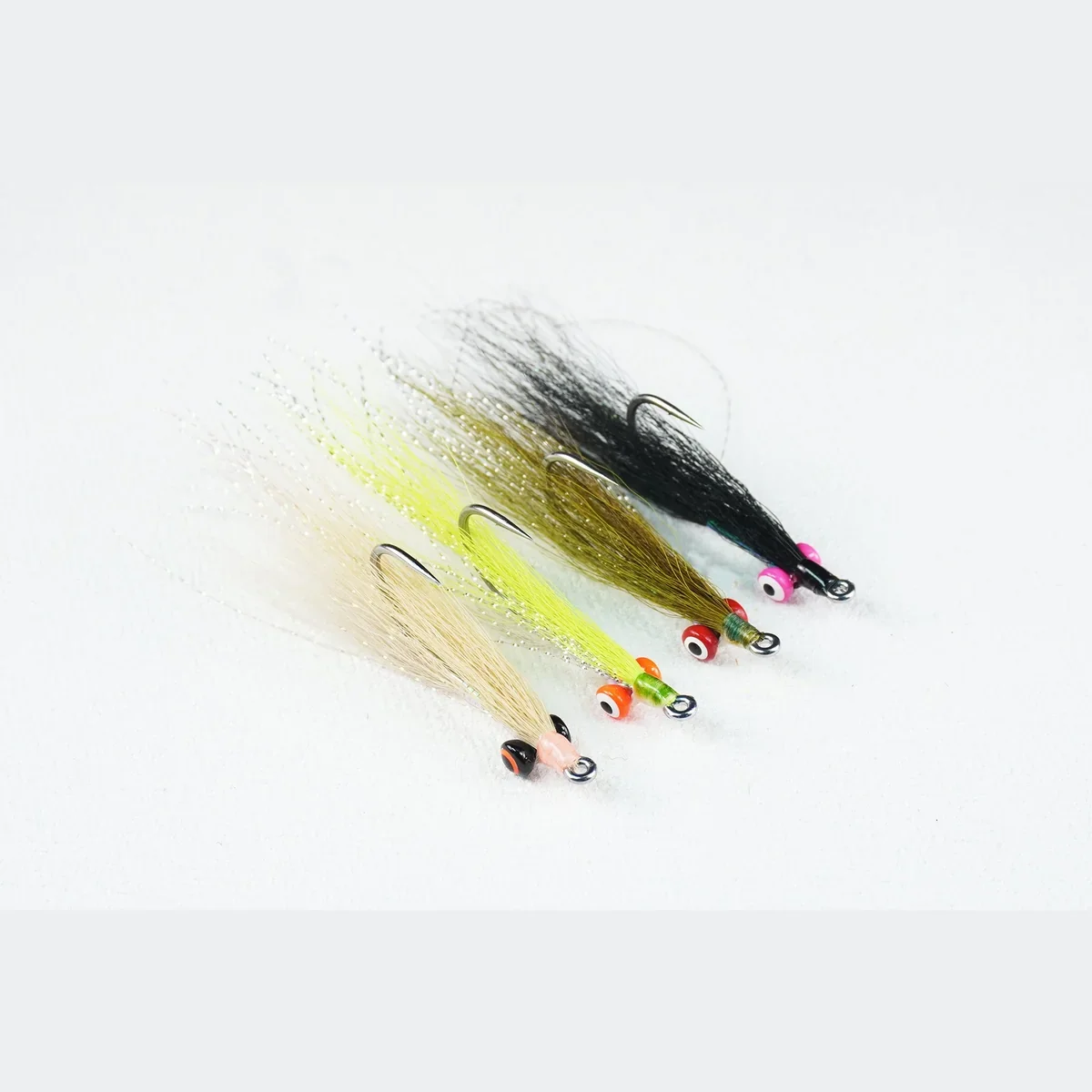
MF Clouser Minnow
Weighted eyes and a slim body that sinks with a jigging action, for the river bend, canal or hole where fish hold deep. #2 and 2/0; Black, Chartreuse/White, Olive/White and Tan/Cream.Product photograph, not shown to scale.
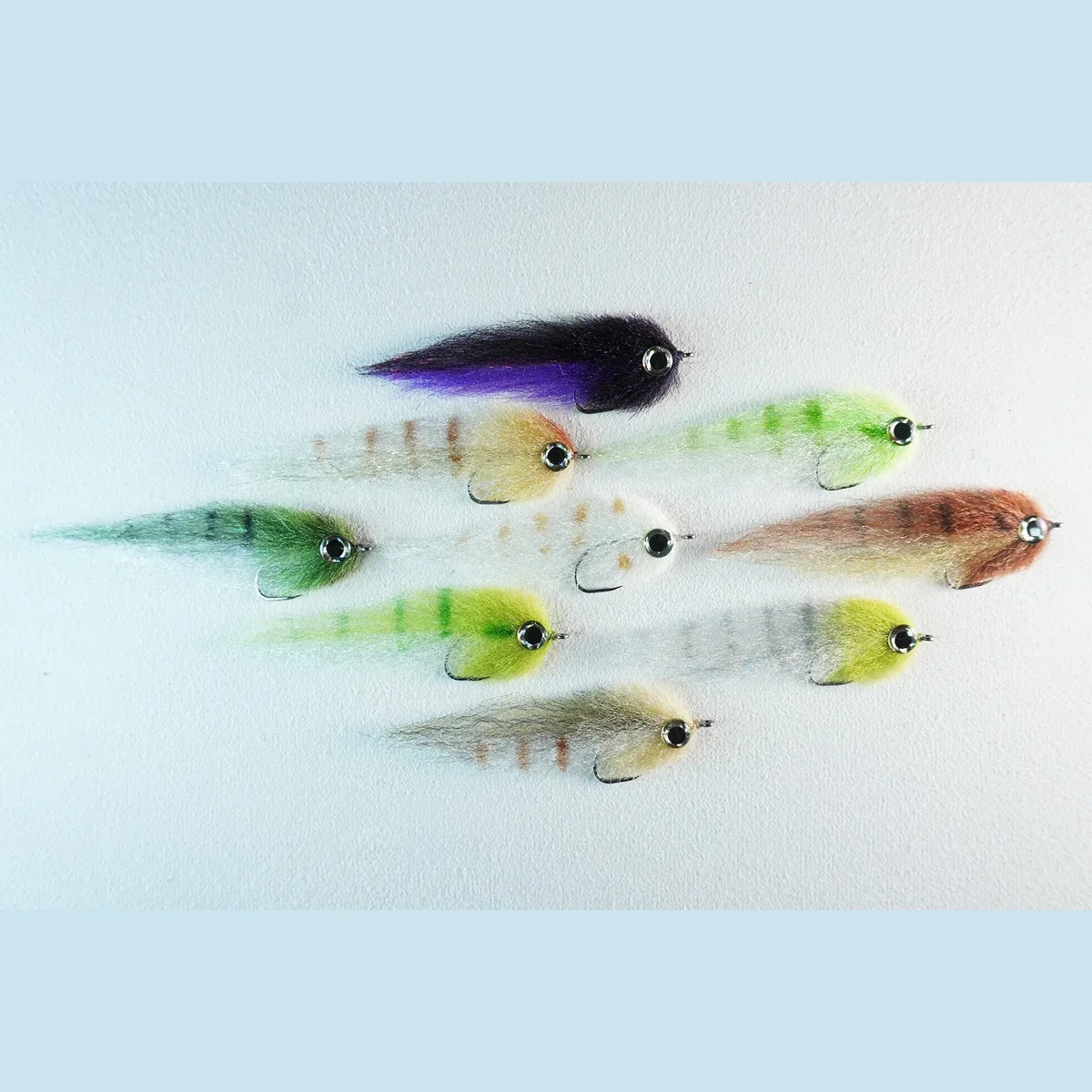
MF Persuader Pinfish
An EP-style synthetic baitfish, about 3.5 inches on a 1/0, for mangrove edges and creek mouths where bait is still around. Nine colors, including Everglades and Brown/Rusty Brown for darker water.Product photograph, not shown to scale.
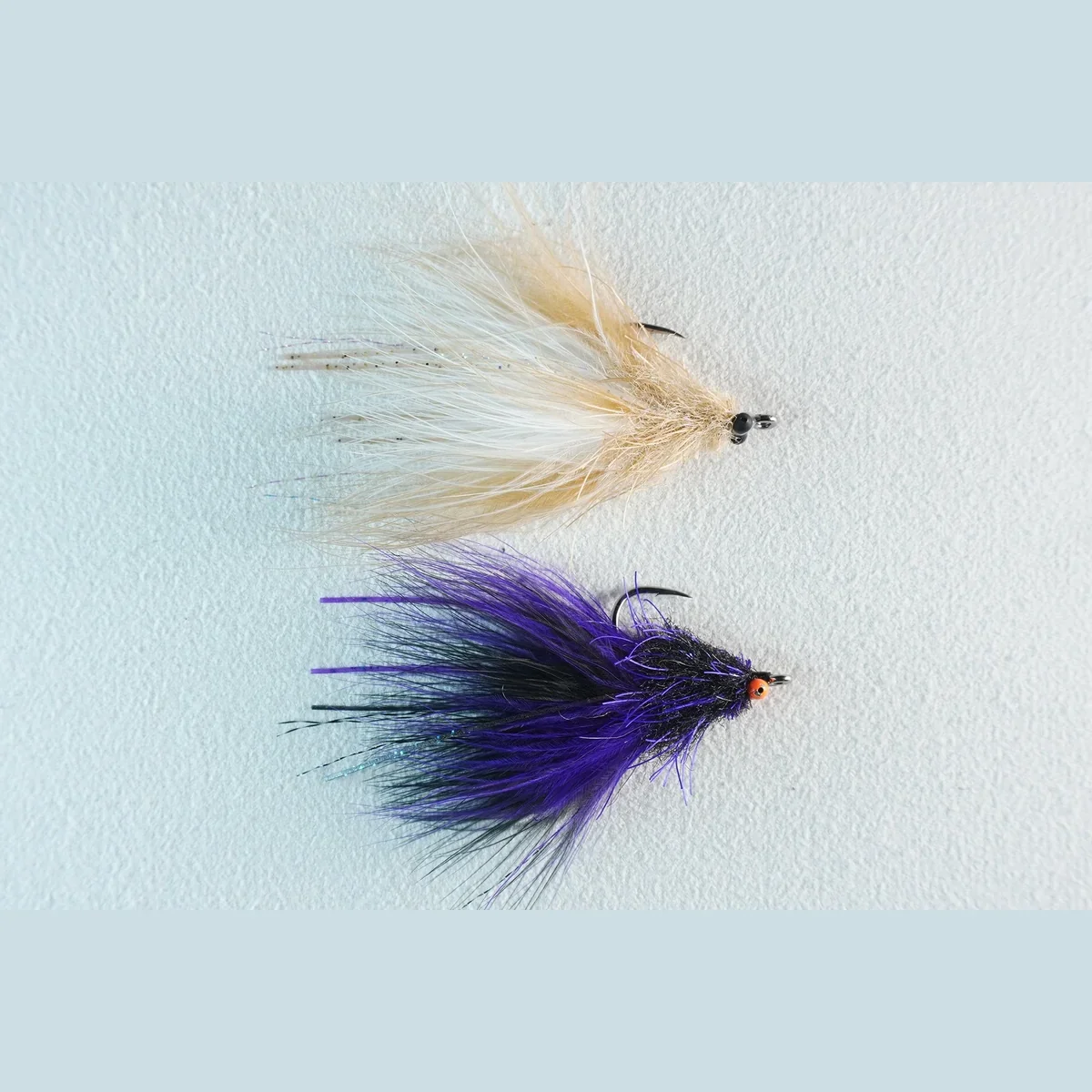
MF Backwater Muddler
A buoyant head that pushes water in shallow, clear water, for the sun-warmed flat on a warming afternoon. Tan and Black/Purple.Product photograph, not shown to scale.
Reading the Calendar of Cold Fronts
There is no formula for fishing a front, but there is a sequence.
Ahead of the front, nothing has changed in the water yet. The fish are where they were, and so is the fishing.
During the front, the wind does most of the damage. A strong north or northeast wind mixes and cools shallow water and can push water out of bays and creeks, leaving unusually low tides. Florida Sportsman’s John Skinner has described those blown-out lows concentrating snook in deeper pockets and potholes, which can make them easier to find.
Immediately afterward, the coldest water may still be coming, as it was at Fort Myers in 2025. Several consecutive cold mornings can shut the bite down entirely. Some veteran guides deliberately wait until the third or fourth day after a hard front before going after big fish.

During the warming interval, the sun does the work. On bright, calm days, shallow flats and the backs of protected canals warm through the morning, and fish slide up from deeper water to sit in them. Even the open Gulf at Clearwater recovered three degrees between late morning and late afternoon on the coldest day. Many guides fish these flats in the afternoon or on a late outgoing tide that drains warmed water off them. Others find the first hours of daylight just as good in water nobody has disturbed. The afternoon is best only when sun, shelter and a few calm days have had time to warm the water. The same logic of reading the front rather than the calendar runs through What a Cold Front Does to a Bonefish Flat.
Cold-Water Handling and the Rules
Florida manages snook by region, and the rules are not the same statewide. On the Gulf coast (the Panhandle, Big Bend, Tampa Bay, Sarasota Bay, Charlotte Harbor and Southwest regions), harvest closes December 1 and reopens March 1, with a slot of 28 to 33 inches total length. On the Atlantic coast (the Northeast, Indian River Lagoon and Southeast regions), harvest closes December 15 and reopens February 1, with a slot of 28 to 32 inches. The bag limit is one fish per person per day where harvest is open. Keeping a snook requires a $10 snook permit in addition to a saltwater fishing license. Biscayne National Park has special snook rules, and Everglades National Park sits outside the Southeast region, so check the boundaries where you fish. During closures, catch-and-release fishing remains legal. Confirm current regulations with FWC before keeping any fish.
The more important rule is not written in a regulation book. A snook out of the water on a 45-degree morning is under real stress. Unhook it in the water whenever possible, keep it there, and let it go quickly. When a severe cold snap arrives and fish are visibly sluggish, stacked in a canal or drifting near the surface, FWC asks anglers not to target them. Report fish kills to FWC at 1-800-636-0511. Those fish are not a fishing opportunity. They are a population trying to survive.
Follow the Water, Not the Calendar
By mid-November, the pass that held fish in September will often be empty on a north wind, and it would be easy to call the season over. It isn’t. The fish are a short way off, in the deeper bend, the protected canal, the creek out of the wind or the flat that has had a full day of sun. The water tells you where to look: how cold it got, how fast it fell, and how long it has had to recover. The angler who stops fishing the date and starts fishing the water will keep finding snook all winter.
Sources and data
Water and air temperatures: NOAA CO-OPS, hourly observations at Clearwater Beach (8726724), Fort Myers (8725520), St. Petersburg (8726520), Vaca Key (8723970), Virginia Key (8723214) and Lake Worth Pier (8722670), averaged by local standard day; accessed October 28, 2026.
- Shafland, P. L. & Foote, K. J. (1983). A lower lethal temperature for fingerling snook. Northeast Gulf Science 6(2).
- Blewett, D. A. & Stevens, P. W. (2014). Temperature variability in a subtropical estuary and implications for common snook. Gulf of Mexico Science 32(1).
- Stevens, P. W. et al. (2016). Resilience of a tropical sport fish population to a severe cold event varies across five estuaries in southern Florida. Ecosphere 7(8).
- Hall-Scharf, B. J. et al. (2025). Increased cold tolerance of a tropical fish species at the northern edge of its expanded range. Estuaries and Coasts 48(2).
- Boucek, R. E. et al. (2017). Can animal habitat use patterns influence their vulnerability to extreme climate events? Global Change Biology. Summary: National Science Foundation.
- Boucek, R. E. et al. (2019). Contrasting river migrations of Common Snook between two Florida rivers using acoustic telemetry. Fisheries Research 213.
- Florida Fish and Wildlife Conservation Commission: snook harvest releases of Nov. 24, 2025, Jan. 29, 2026 and Apr. 28, 2026; saltwater licenses and permits.
- Sargeant, F. How to Find and Catch Florida’s West Coast Snook this Winter. Florida Sportsman, Oct. 29, 2024.
- Skinner, J. Low & Cold: Successful Post-Front Fishing for Snook, Redfish and Trout. Florida Sportsman, Feb. 5, 2025.
- Klopfer, J. Fly Fishing for Snook in Florida Rivers. AvidMax.
- Chinnis, R. Reel Time: Cold water strategy. AMI Sun, Jan. 4, 2023.
- Winter snook report, Salt Water Sportsman (Dave Markett).
- Florida Freeze Triggers Widespread Snook Kill. Coastal Angler, Feb. 6, 2026.
