

Outside the Bait Ball: How to Present a Fly to Snook During the Mullet Run
Megafin Journal · Seasonal Windows
Outside the Bait Ball: How to Present a Fly to Snook During the Mullet Run
During the mullet run, more bait can mean fewer eats. The fix isn’t a better fly — it’s where the fly travels. Edge tactics, three presentations, and how to pick a fly by the job it has to do.

Every fall, finger mullet pour down Florida’s beaches and through its inlets by the millions, and the predators line up behind them. The headline fish are snook, tarpon, and jack crevalle, and on the right morning you can watch them crash bait against a seawall or blow up along the beach in knee‑deep water. It is some of the most visually intense feeding of the year. It is also some of the most frustrating fly fishing you will ever do.
The reason is counterintuitive. More bait does not make a snook easier to catch. When there are ten thousand real mullet in front of a fish, your fly is not a rare opportunity — it is object number ten thousand and one, drifting through the same water as everything else. The problem during a heavy run is rarely the fly. It is getting that one fly noticed, and then making it look like the easiest meal in the school. As MidCurrent put it in its fall mullet coverage, the pattern matters less than where you put it.
So the real question of the mullet run is not what to tie on. It is: where should my fly travel so a snook reads it as an interceptable target, and not as one more mullet in the crowd? Everything below is about answering that.
Why Casting Into the Center Usually Fails
Dropping a fly into the middle of the bait ball feels right. That is where the fish are, after all. But a fly in the center competes with its surroundings on the surroundings’ terms. It is one silhouette among thousands of identical ones, and a predator working a school has no reason to pick it out.

Predators tend to hunt the seams of a school, not its heart. Cruising snook, tarpon, and jacks single out stragglers — the fish at the margins, the ones slightly out of formation, the ones that look easier to run down than a tightly packed mass. That is field observation more than proven biology, but it is consistent across saltwater guiding, and it lines up with how ambush feeders behave: they use structure and edges to trap bait against something and pick off what gets isolated. A fly buried in the center rarely reads as isolated. A fly tracking the outside edge, or swimming away from the school toward open water, reads exactly like the straggler a snook is already looking for.
There is also a visibility problem. In low light and stained back‑bay water — prime mullet‑run conditions — fish find a baitfish as much by feel as by sight. A blunt, water‑displacing shape is what a predator locates by its lateral line in those conditions. Buried in the middle of the school, your fly’s pressure wave is lost in a thousand others. On the edge, it has a chance to stand alone.
Don’t fish the bait ball. Fish the predator’s interception zone.
Read the Bait Before You Cast
The anglers who convert mullet‑run activity into eats spend more time watching than casting. Before the fly leaves the rod, a few things are worth reading.

Start with direction and density. Which way is the school moving, and is it loose or packed tight? A relaxed, spread‑out school is often unbothered; a school that suddenly compresses, sprays, or showers is reacting to something underneath it. Nervous water, a sudden spray of fingerlings, or bait pinned against a wall or a sandbar all mark where a predator is working. Those are the schools worth casting to.
Then read the current and the structure. Bait gets funneled — against seawalls, along dock lines, through cuts and inlets, over the lip of a trough. Predators know these funnels and sit where the current delivers food to them. If you can see where mullet repeatedly bottleneck, you have found where a snook is likely to be waiting, which tells you where the fly needs to swim. And note the light: guides consistently rate the mullet run best at first and last light, when snook move shallow and feed with less caution.
The point of all this watching is simple. You are not trying to cast at bait. You are trying to place a fly where a predator is already set up to intercept it.
Work the Edge, Not the Middle
If there is one habit that changes mullet‑run fly fishing, it is fishing the edge. Both of the sources behind this piece land here independently: Orvis’s Capt. John Meskauskas advises fishing the outer edges of the mullet schools, and MidCurrent’s presentation advice is to work the perimeter, not the middle — cast to the far side of the school so the fly swims back along the outside edge.

That second detail matters. Casting beyond the school and retrieving so the fly tracks along its outer margin, or peels away from it into open water, does two things at once: it keeps the fly out of the visual clutter, and it gives the fly the behavior of a fish that has broken from the safety of the group. That is the profile of an easy meal.
There is no single best edge, though. The productive edge shifts with the predator and the current. The leading edge, ahead of a moving school, can hold fish that race up to cut bait off. The trailing edge collects the stragglers and the wounded. The shore‑side edge is where bait gets pinned against the beach or a wall and has nowhere to go. The current‑side edge is where moving water sweeps isolated fingerlings to waiting fish. Which one is working depends on where the pressure is coming from that morning — so read the feed, pick the edge the predators are actually using, and put the fly there rather than defaulting to whichever edge is the easy cast.
There is no single best edge. The productive one shifts with the predator and the current.
Three Presentations for Three Kinds of Water
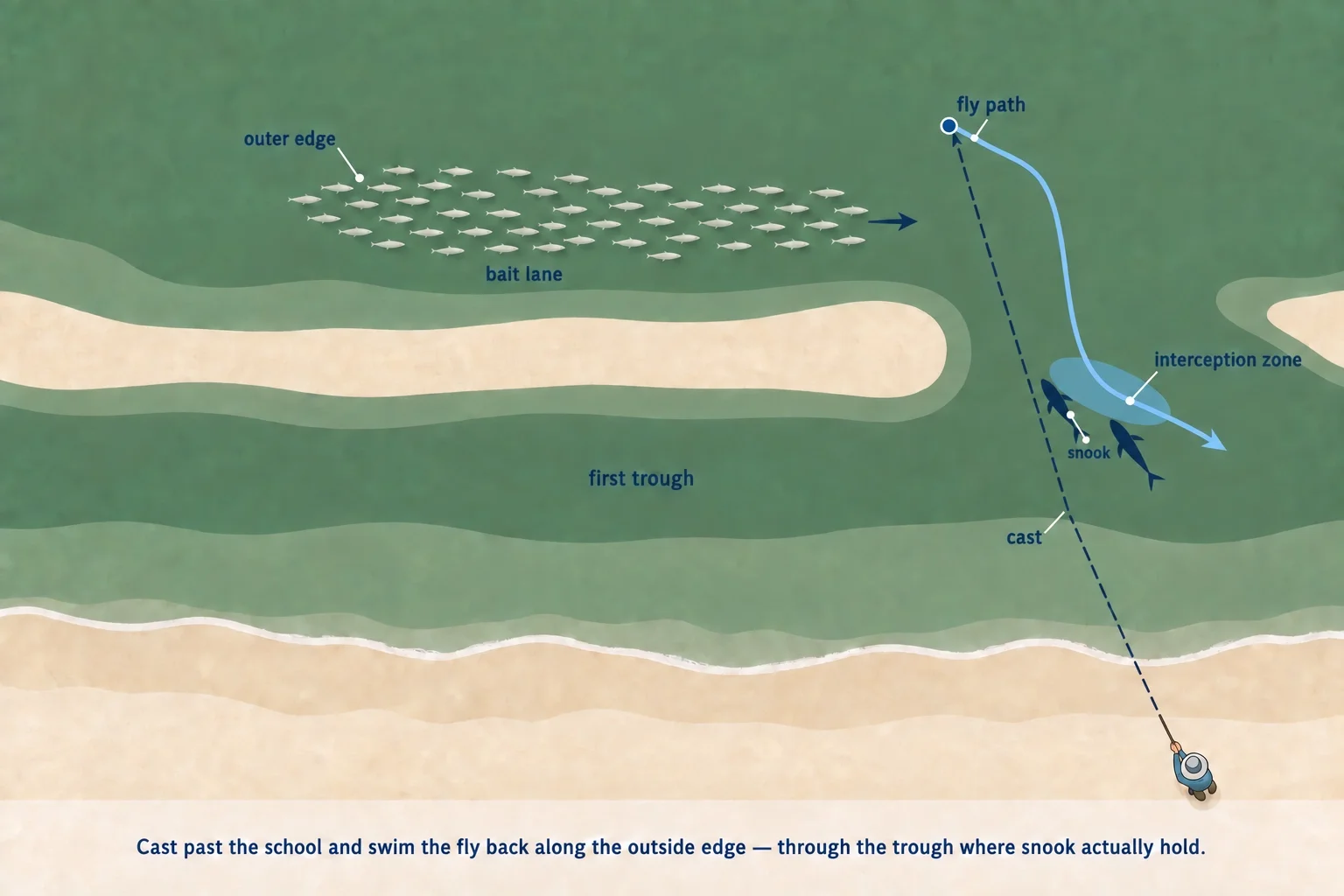
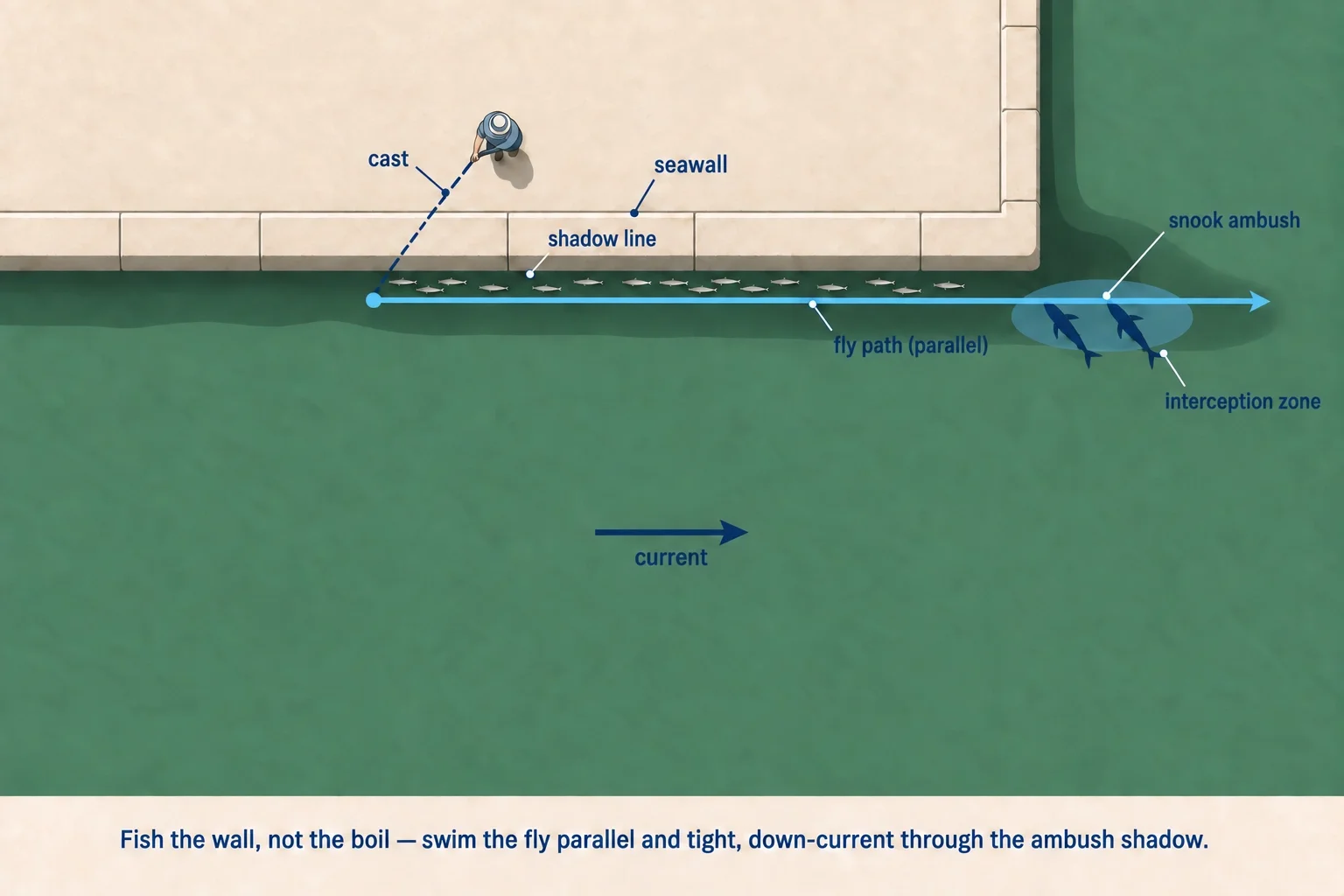
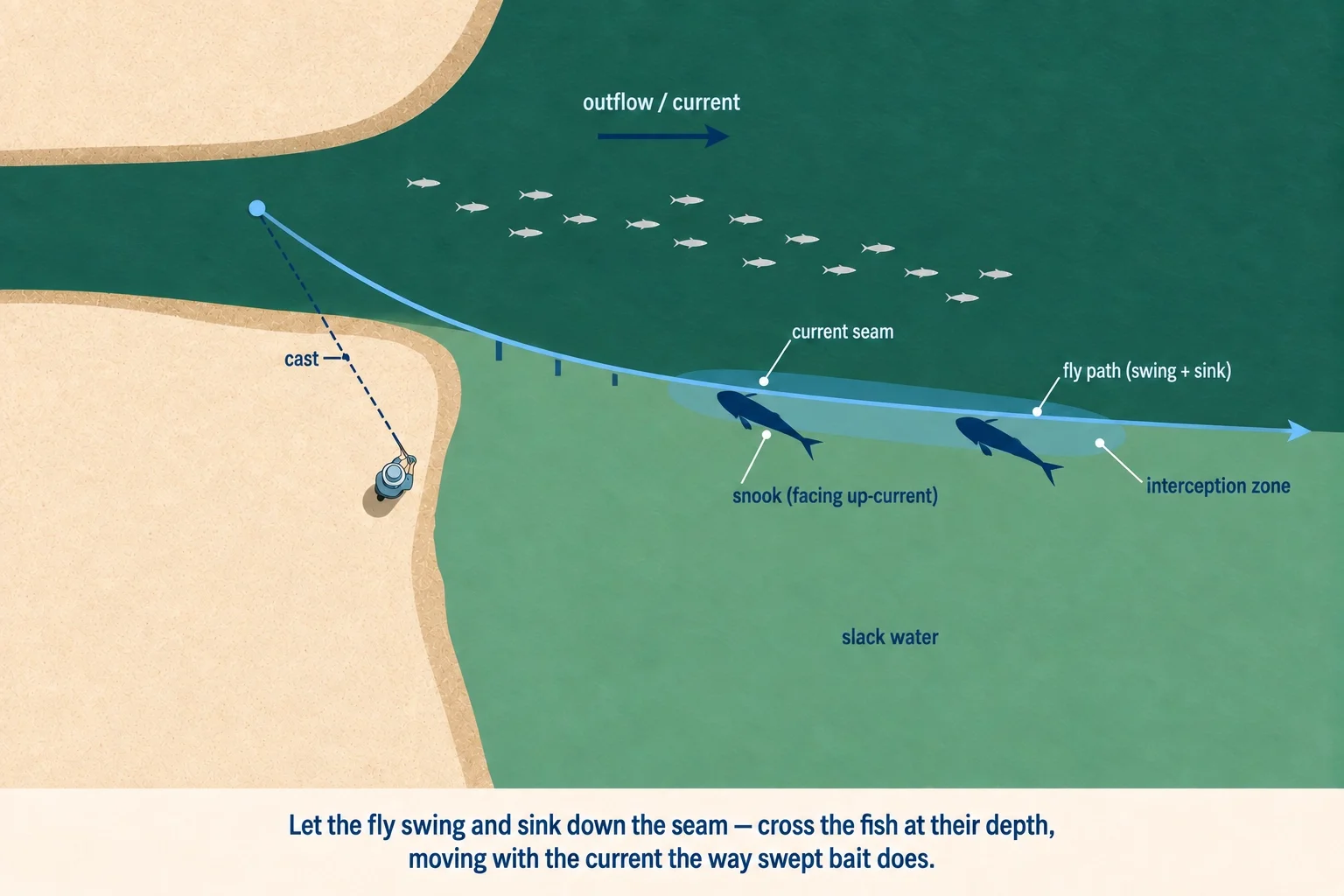
The edge principle looks different in different water. Three situations cover most of the mullet run, and each one changes where the fish sits and where the fly has to go. The diagrams below show each one from above.

1. The Open Beach and Surf
Along the beach, mullet travel south in a lane close to shore, often just outside the first bar, and predators cruise the trough between the bar and the sand or hold along the outside of that bar. Position yourself so you are casting roughly parallel to the beach or slightly outside the bait lane, not straight out to sea. Put the fly beyond or ahead of a moving school and retrieve so it swims back along the outer edge and through the trough, in the same direction the bait is traveling or angling away from the school toward open water. A clear intermediate line on a 9- or 10-weight is the default here — it puts the fly two to three feet down, under the surfaced crowd and into the water where fish actually hold.
2. The Seawall and Hard Structure
Walls, bridges, docks, and jetties are ambush architecture. Snook use them as ambush points, tucking tight to the structure — often on the down‑current side or in the shadow line — and pinning mullet against it. Here the fly should travel parallel to the structure and close to it, so it swims through the strike zone for as long as possible, rather than being cast perpendicular and dragged straight away from the wall after one foot of productive travel. Lead the fly past the shadow line and the corners where fish stage, present up‑current, and let it swim back down naturally with the flow, the way a disoriented mullet would move. Because these fish live against abrasive concrete, pilings, and oyster, a heavy fluorocarbon bite tippet — 30 to 60 pounds by species — is for abrasion resistance, not stealth; during the blitz the fish are keyed on food, not line‑shy.
3. The Channel Mouth and Current Exit
Inlets, passes, cuts, and channel mouths are the highest‑percentage water of the run because they concentrate everything. Fish them first, then the beaches with a deep first trough. Snook hold in the current seam — the line between moving and slack water — and along the edges of the outflow, letting the current sweep bait to them. Cast up‑current and across, and let the fly swing and sink down the seam, so it crosses in front of holding fish at their depth, moving with the flow rather than fighting it. This is where getting down matters most; carry a faster‑sinking option for deep cuts, around bridges, or at night.
Match the Profile Before the Color
When fish are keyed on mullet, silhouette and size do more work than exact color. Match the juveniles, not the adults — gamefish key on finger mullet, so build around three- to five-inch flies on No. 1 to 3/0 hooks. And width matters more than length: a fat three- to four-inch fly usually outfishes a long, thin six-inch streamer, because the wide, blunt shape is what a predator locates by feel in dirty water and low light.

This is where construction becomes presentation, a theme we covered in The Material Is the Fly: the materials a pattern is built from decide how much water it pushes, how it holds its profile when wet, and how it sinks. A hollow, water‑pushing head behaves nothing like a thin, streamlined wing, even at the same length. Choose the build that produces the blunt mullet profile you’re seeing, then worry about color.
On color, the sourced approach is straightforward. Start with white, silver, and green‑over‑white for light silver mullet on a clear beach, and darker olive, gray, and brown for stained back‑bay water. Then keep the fly most anglers skip: when a heavy run stops producing on standard colors, a dark or off‑match fly — all‑black, dark olive, sometimes purple — stands out against a bright surface and reads clearly in a crowd of near‑identical silver naturals. The dark fly is not magic; it is contrast, and contrast is what gets one fly seen in a wall of the same thing.
Three Flies, Three Jobs
Fly selection during the run is best framed as jobs, not favorites. Three presentation problems call for three different tools, and the mistake is treating similar‑looking flies as interchangeable.
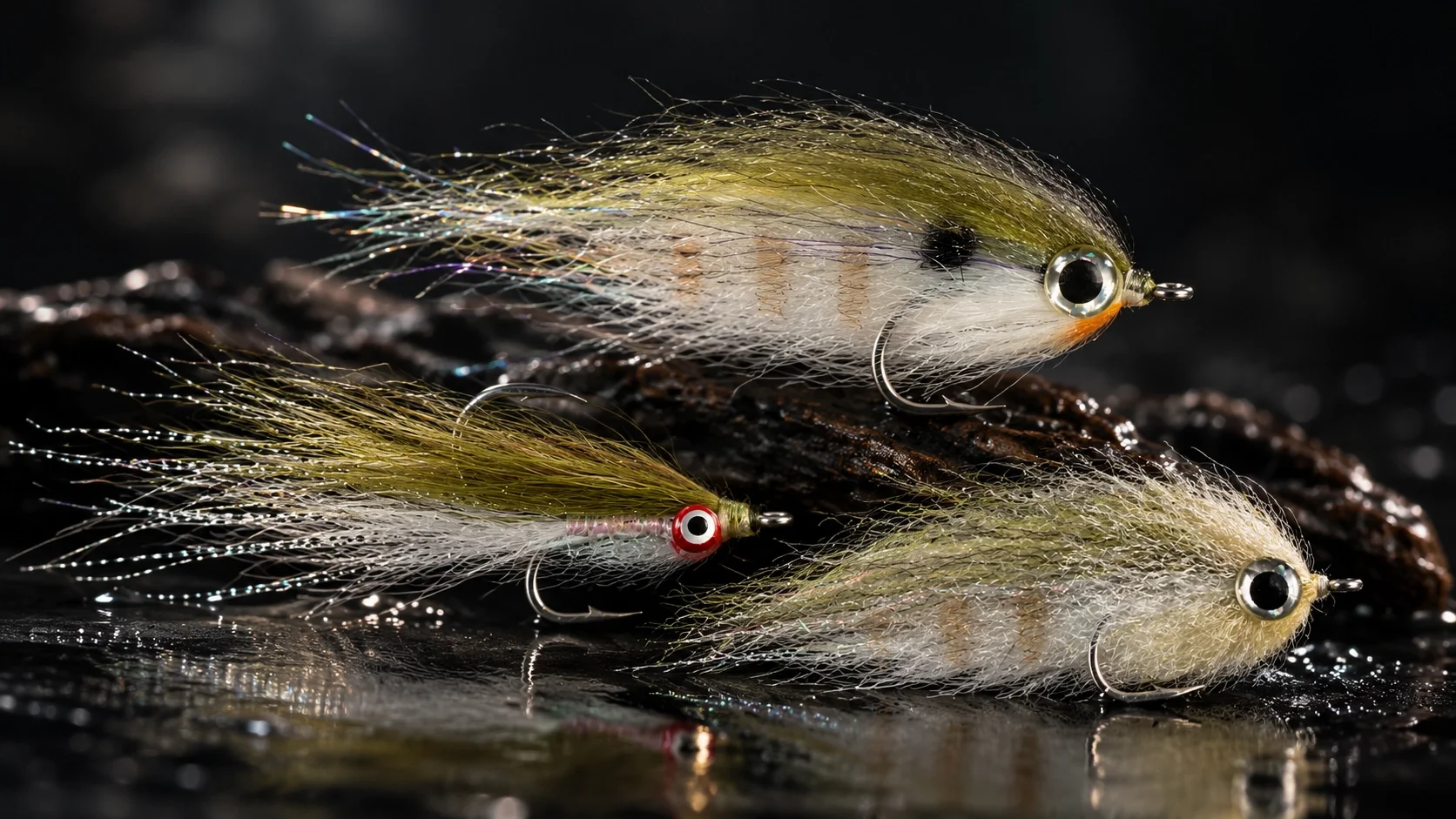
The first job is getting down and jigging in current — the channel mouth, the deep trough, the bridge at night. That is the Clouser’s job. Its weighted eyes sink it fast, ride the hook point up, and give it a darting, jigging fall, and it imitates almost all baitfish; many eats come as it drops.
The second job is pushing water at mid‑column with a full mullet profile — the beach trough, fish hunting by feel in stained water. Megafin’s Persuader (Pinfish) is a fuller‑bodied baitfish pattern that fits the wide, blunt silhouette this situation rewards. Match its size to the finger mullet you’re seeing.
The third job is slipping a clean, natural baitfish past selective fish — the clear beach, the pressured edge fish that refuse the bigger, louder options, the tight cast in shallow water. That is where the Mini Hammer Baitfish earns its place: a compact, weighted four‑inch fly on a 1/0 hook that cuts through the water in subtle, erratic bursts, reading like a startled or struggling mullet rather than a fly being retrieved. It even comes in a Mullet color, alongside Shad, Green/Grey, Bleeding Head, and Purple/Black.
The lesson is the diagnostic, not the lineup: decide what the fly has to do — sink, push water, or slip past clean — then pick the pattern built for that job.
Let the Retrieve Follow the Bait
There is no universal mullet‑run retrieve, because the retrieve has to imitate what the bait is doing in that spot. The starting point is a searching one: long one- to two-foot draws with pauses, and when bait showers, cast in, let the fly sink, then strip it erratically like a wounded mullet. Predators are looking for the fish that can’t keep up, so the fly that hesitates, falls, and bolts often draws the eat that a steady strip won’t.
From there, let three things set the pace. Bait speed: when fingerlings are fleeing hard, a faster retrieve matches them; when the school is milling, slow down. Predator behavior: fish crashing on top want a fly worked near the surface; fish boiling deep want it down and slower. Current: near structure and in seams, often the most natural presentation is barely any retrieve at all — let the flow move the fly and stay tight for the eat, which frequently comes on the swing or the drop. Match the fly’s motion to the bait’s, not to a habit.
When to Stop Casting at the Same School
Persistence has limits during the run. If a school has produced nothing after honest effort, or fish are feeding all around the fly and ignoring it, the presentation needs to change before the fly does. Work through the variables in order of impact:
First, position — are you casting into the center instead of the edge, or are the fish actually on a different school or a nearby ambush point? Then angle — is the fly swimming with the bait and along the edge, or crossing the school unnaturally? Then depth — a fly riding over fish that are holding two to three feet down will be ignored no matter how good the pattern is; get it to their level. Then profile — step to a wider or narrower silhouette to match the mullet you’re seeing. Then retrieve — change the cadence, add longer pauses, or let the current do the work. Only after all of that should you change the pattern, usually to a dark, contrasting fly to stand out from the naturals. Most refusals are solved above the pattern line, not at it.
If you’re building a broader travel or seasonal box around this fishing, our Florida Keys Fly Box guide covers the wider selection.
Observe first. Select second.
The mullet run rewards observation over volume of casts. Read the school, find the edge the predators are using, put the fly where a snook is set up to intercept it, and make it behave like the one mullet that got separated from ten thousand others. Do that, and the fly you tie on becomes a decision instead of a guess.
Megafin Snook Assortment
A box built to cover the three jobs above — sink, push water, and slip past clean — so you can match the fly to the bait and the water in front of you.
Choose a snook fly for the bait you’re seeing
One responsible note: snook are tightly regulated in Florida, with slot limits, seasonal closures, and a required permit, and the rules change — confirm current regulations with the FWC before keeping a fish, and handle release fish quickly and in the water.
Common questions
Where should I cast during the mullet run?
To the edge, not the center. Work the perimeter — cast past or to the far side of the school so the fly swims back along the outside edge, where cruising snook single out stragglers. A fly buried in the middle is just one of thousands.
What’s the best fly for snook during the mullet run?
There isn’t one — there are three jobs. Match a wide, water-pushing 3–5″ profile to the finger mullet, carry a weighted pattern to get down in current, and keep a dark, contrasting fly for when the naturals win. Pick by the job the fly has to do.
What fly line should I use from the beach?
A clear intermediate line on a 9- or 10-weight is the default; it puts the fly two to three feet down, under the surfaced bait where fish hold. Carry a floating line for topwater and a faster sinker for deep cuts, bridges, or night.
When is the fall mullet run in Florida?
First pods generally appear in late August, the run builds through September, and it peaks from mid-September into October. Snook are tightly regulated — confirm current slot, season, and permit rules with the FWC before keeping a fish.
Why won’t snook eat my fly when there’s so much bait?
Because your fly is one object among thousands of real ones. Before you change patterns, change position, angle, and depth: fish the edge, get the fly to the fish’s level, and make it behave like an isolated, struggling mullet.
