
Below the Swing: Keeping a Smallmouth Streamer in the Strike Zone
Megafin Journal · Technique & Presentation
Below the Swing: Keeping a Smallmouth Streamer in the Strike Zone
A sink tip doesn’t put your fly at the fish’s level. In current, depth is something you steer on every cast — with angle, sink time, tension, and retrieve.

You did everything right. You read the run, picked out the seam beside the current, and put a good cast well above it. You even switched to a sink tip that morning because the fish were holding deep. The fly swung through, you felt the line come tight at the end, and nothing happened — not on that cast or the ten after it.
The problem usually isn’t the fly, and it isn’t the pattern. It’s that the fly spent almost none of its swing at the level of the fish. It sank toward the zone, passed through it for a moment, and then climbed back out as the line came tight. In current, keeping a streamer in the strike zone is a much shorter, more deliberate window than most anglers think, and a sink tip alone doesn’t buy it for you.
This is about that window: how to find it, how to lengthen it, and how to stop fishing over the top of fish that are right where you thought they were.
A Sink Tip Is Not a Depth Setting
The most useful thing to unlearn is the idea that a line’s sink rate is a depth. It isn’t. A line rated at six inches per second describes how fast it falls in still water, not where your fly ends up in a river. As MidCurrent points out, the same six‑ips line gets deep far faster in a slow pool than in a fast run, because current is constantly lifting the line and the fly and sweeping them downstream before they can drop.

It’s also worth separating two numbers that get confused. Grain weight is the mass of the line — what loads your rod. Sink rate is a function of the line’s density, its “type,” not its grains. A heavier line is not automatically a faster‑sinking one. When you choose a sink tip, you’re choosing a density and a tip length for a given speed of water, and Scientific Anglers builds them in tiers for exactly that reason: an intermediate tip that fishes just under the surface, a Sink 3 that falls at roughly two and a half to three and a half inches per second, a Sink 6 that falls closer to six. In moving water, the practical tool is almost always a sink tip — a floating body with a short sinking front — rather than a full‑sinking line, because you still need to mend and manage the belly on the surface.
None of those ratings tells you your fishing depth. They tell you how quickly the fly starts to get down. What it does after that is up to the current, the angle of your cast, and how much tension you let into the system.
A sink rate is not a depth. It’s only how fast the fly starts getting there.
Where a River Smallmouth Actually Sits
Depth only matters relative to the fish, so it helps to be precise about where a river smallmouth holds.

They are energy‑efficient animals that rarely sit in the hardest current. Instead they tuck into the soft water immediately beside it — the eddy behind a boulder or a bridge piling, the seam where fast water shears against slow, the heads and tails of pools — facing upstream and making short, efficient moves into the flow to intercept food the current delivers. In turbulent seams they lean on the lateral line, which is why a fly that darts and then falls draws a reaction even when the water is stained.
That behavior sets the target. The fish is not in the middle of the fast water; it’s on the soft edge of it, usually near the bottom, watching the seam. The standard river presentation follows from that: put the fly into or above the fast side and bring it through the seam so it crosses the fish’s window moving the way real food moves — with the current, not against it. Your streamer has to be at the fish’s level during that short crossing, not before it and not after.
The Anatomy of the Swing
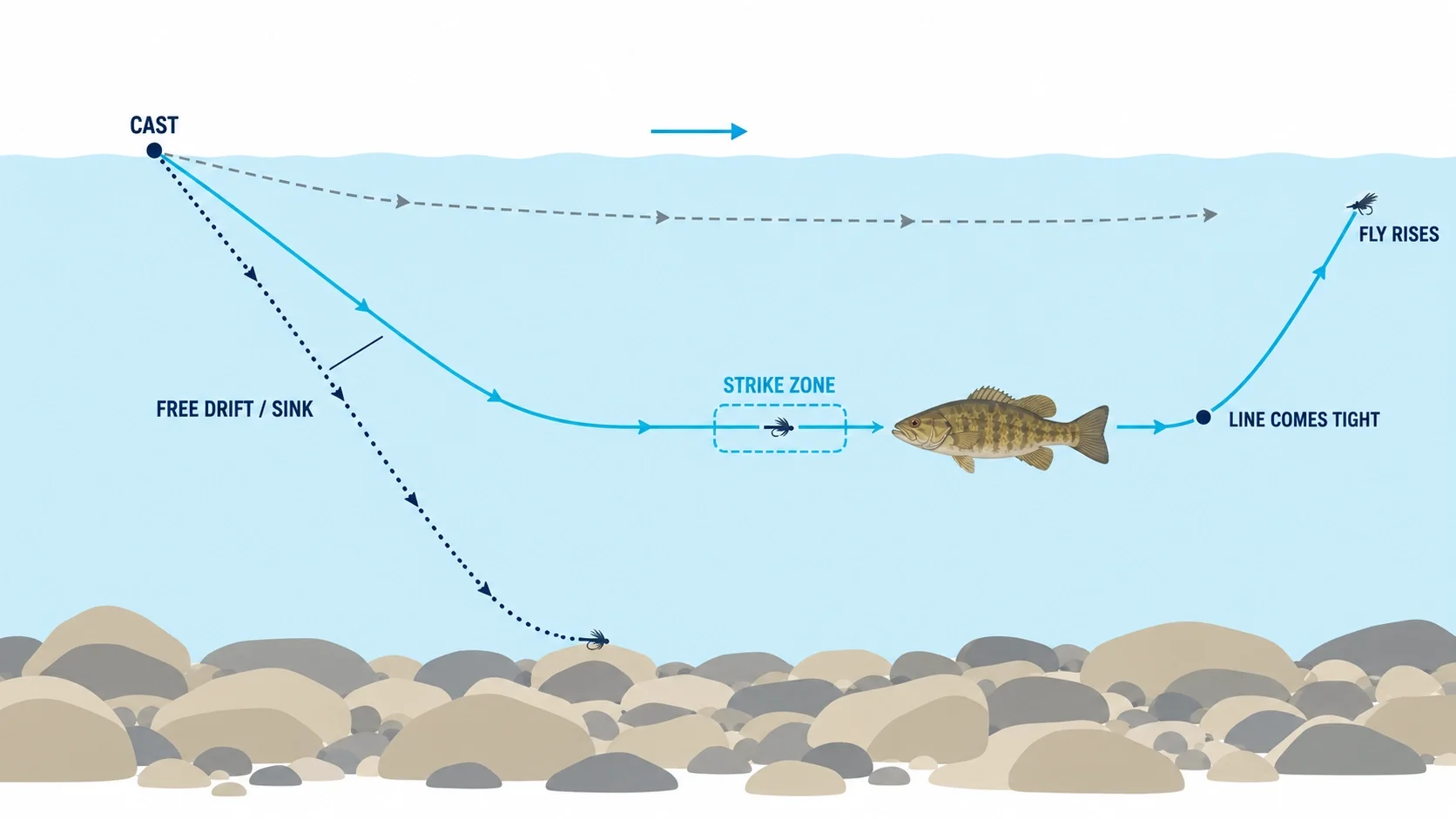
Picture the swing from the side. You cast up and across, the fly drops on a slack line, and for a few seconds it sinks toward the bottom — this is where it enters the zone. Then the current loads the belly of your line, tension builds, and the line begins to swing downstream and tighten. The moment it comes tight, that tension starts lifting the fly. Orvis describes this directly for heavy streamers and sink tips: at the end of the drift, letting the line come tight brings the flies and the sinking tip back toward the surface.
So a single swing has a depth curve. The fly sinks in, tracks through the zone briefly, then planes up and out as the line tightens. The productive water is below the swing — the part of the arc before tension takes over. This also explains a pattern Orvis notes in the takes themselves: most strikes come right after the first strip or just as the fly begins to swing, and the follow‑up eat often comes on the pause, when the fly falls and “dies.” Smallmouth prefer to take a fly as it’s dropping. The eat and the depth window live in the same early part of the swing, which is exactly the part most anglers rush through on their way to the tight‑line hang at the end.
Three Lines Through One Run
Take one run and imagine three fly paths through it, because the difference between them is entirely presentation, not fly choice.
-
Path AToo high
The cast lands across rather than up, the line comes tight almost immediately, and the fly planes just under the surface, a foot or two over the heads of fish sitting near the bottom. It looks like fishing. It catches nothing, and the angler blames the pattern.
-
Path BToo deep
The fly gets down, but the cast and mend give it so much slack for so long that it sinks below the fish and ticks rock, fouling or hanging up before it ever swings through the window at the fish’s level.
-
Path CThrough the zone
The cast goes up and across, an upstream mend buys a measured amount of sink time, and the angler lets the line come tight just as the fly reaches the seam — so the fly is at the fish’s level during the crossing, and only begins to climb after it has passed the holding water.
The Four Dials You Actually Control
Once you stop thinking of depth as a line rating and start thinking of it as an outcome you steer, four controls do the work.

Depth, steered
- Angle.
How far up‑current you cast decides how much time the fly has to sink before tension arrives. A cast quartered well upstream drops the fly deeper and earlier; a cast thrown across gets tight fast and stays shallow. Aim so the fly’s sink lines up with the fish’s position, not so it merely reaches the far bank.
- Sink time.
After the cast, an upstream mend throws slack into the line and lets the fly drop into the slot before the current starts dragging it — the same move a nymph angler uses to get a fly down. More mend and a longer pause buy depth; less buy a shallower, faster swing.
- Tension.
The one most anglers ignore. The instant your line comes tight, you’ve stopped fishing deep and started fishing the rise. Managing when tension arrives — by mending, feeding line, or leading and following the fly with the rod tip — is how you decide where in the run the fly is at its deepest.
- Retrieve.
Inside the swing, a strip‑and‑pause keeps the fly in the zone longer than a steady strip and matches how smallmouth want to eat. Strip to give it life, then pause to let it fall; the fall is the trigger. If a motionless drift draws nothing, a few small twitches with a long rest between them is the next thing to try before you speed up.
Reading the Eat
Because the productive window is early and often on the drop, the take is easy to miss. On a floating line or the floating body of a sink tip, watch where the line meets the water: a hesitation, a twitch, or the line jumping forward is frequently a fish that ate on the fall.

Line, Leader, and the Fly That Shows You the Zone
Set the depth with the line and the fly, not with wishful thinking. In water to about five feet with a weighted fly, a floating line and good mending will get you there and let you fish the softer, shallow pockets that sinking lines skate over. For deeper runs and heavier current, a sink tip earns its place — and when you fish one, keep the leader short, no more than about four feet, so the tip actually pulls the fly down instead of letting it ride up on a long, buoyant leader.

The fly is the other half of the depth equation, which is why the Clouser is the honest reference point here: Bob Clouser designed it in the late 1980s for exactly this fish, and its weighted eyes do two jobs at once — they flip the hook point up so it rides through rock with fewer snags, and they make it dive and jig on the pause, which is the drop smallmouth key on. The weight of those eyes, and the size of the fly, are your depth adjustment. A lighter, smaller Clouser holds a shallow seam; a heavier one on a larger hook gets down in a fast run without forcing you onto a heavier line. If you want the fuller logic of how a fly’s build changes how it sinks and holds a profile, we covered it in The Material Is the Fly.
Change the Presentation Before the Fly
When a run that should hold fish comes up empty, resist the urge to cut off the fly first. Work the presentation in order of impact:
- Angle — cast farther up‑current to buy sink time.
- Sink time — a bigger mend, a longer pause before you come tight.
- Tension — hold the fly deeper through the seam before you let it climb.
- Fly weight — a heavier or lighter pattern for the speed of the water.
- Line — only then move to a faster‑sinking tip.
Most of the time the fly was fine; it was simply fishing above the fish, and the cure was three feet of depth you could have steered without opening a fly box.
Choose the weight, choose the depth
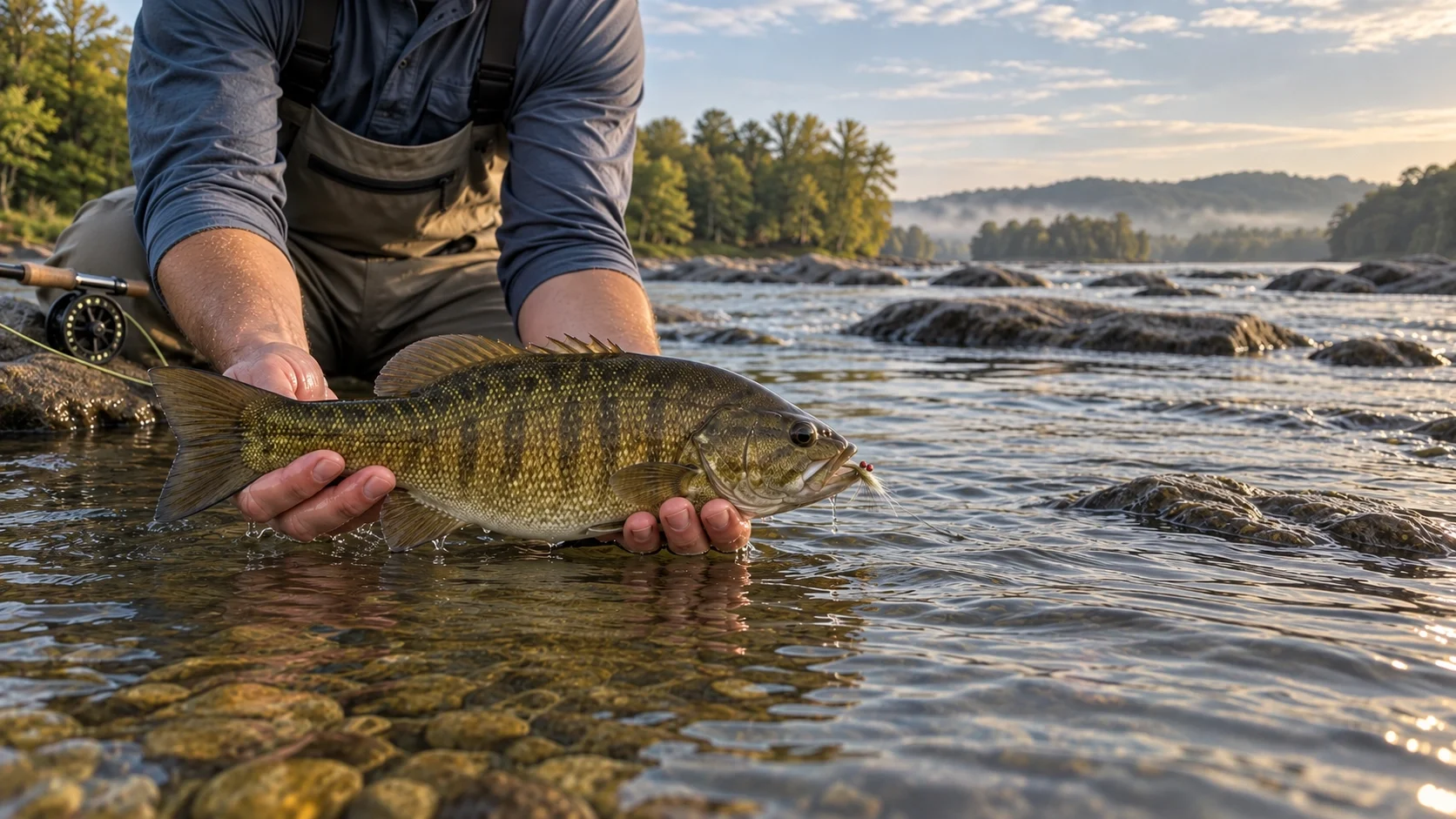
Megafin Clouser Minnow
Weighted eyes, offered in #2 and 2/0. The choice isn’t which fly — it’s which weight the water in front of you calls for: the lighter #2 for a shallow seam, the 2/0 to get down in a faster run without changing lines.
Choose a streamer for the depth you needGet that right and the same runs you’ve been swinging start producing, because for the first time the fly is spending its best seconds where the fish is actually looking.
Depth in a river isn’t a number on a line. It’s a decision you make on every cast.
Common questions
Does a sink tip guarantee my streamer is deep enough?
No. A sink rating describes how fast the line falls in still water. In a river, current lifts the line and fly, so the same tip fishes deeper in a slow pool than in a fast run. Angle, mending, and when the line comes tight decide the real depth.
Why do I lose depth at the end of the swing?
When the line comes tight in the current, tension lifts the fly and sink tip toward the surface. The productive part of the swing is the early part, before tension takes over — which is also where most strikes come.
What’s the best streamer retrieve for river smallmouth?
A strip followed by a pause is a strong starting point, especially with a weighted fly, because smallmouth often take a fly as it drops. If that draws nothing, try small twitches with long rests before speeding up.
Floating line or sink tip for smallmouth streamers?
In water to about five feet, a floating line with a weighted fly and good mending usually gets there. In deeper runs and heavier current, a sink tip with a short leader — about four feet or less — helps keep the fly down.
