

Match the Bait, Not the Blitz: Reading the Fall Striper Run
Megafin JournalStriped bass · The fall run
Match the Bait, Not the Blitz: Reading the Fall Striper Run
Every fall the striped bass follow the bait south, and the bait changes every few weeks. What the science says stripers eat in autumn, how to tell peanut bunker from anchovies from sand eels at a glance, and why the fish you release this year matter more than usual.

The birds find it first. A few terns start picking at the surface off the end of the jetty, then a dozen, then the water underneath them goes white and the sound carries all the way to the beach. Striped bass are crashing bait in a tight circle maybe eighty feet out. You make the cast, strip hard through the middle of it, and nothing happens. You do it again. Fish are boiling on both sides of your fly. A man thirty yards down the rocks hooks up twice before you get a touch.
What he figured out before you did wasn’t where to cast. It was what the bass were eating.
The fall run along the Atlantic coast is often described as a fish migration. It is closer to the truth to call it a bait migration with striped bass attached. Young menhaden leave the bays, anchovies bring blitzes to the points, sand eels move in off the offshore shoals, and the bass follow whatever is moving. The bait changes every few weeks, and the fly that worked on the last tide can be the wrong size, the wrong shape and the wrong depth on this one.
Why the run moves
Striped bass spend most of their adult lives in coastal waters and move up rivers to spawn in spring. In the ocean they generally move north in summer and south in winter, according to the Atlantic States Marine Fisheries Commission, with important wintering grounds from offshore New Jersey to North Carolina. The Chesapeake Bay produces most of the coastal migratory stock, with real contributions from the Hudson and Delaware.
What gets the fish moving in the fall is a combination of cues, and falling water temperature is one of them. The National Oceanic and Atmospheric Administration has tracked the arrival of migratory fish in the Chesapeake against a reference point of 55°F at its Gooses Reef buoy. In 2012 the water there first reached 55°F on November 4, and the big migrants didn’t reach the middle of the bay until after Thanksgiving. NOAA is careful to say that “many other things influence the movement of these fish.”
Anglers have their own map, built from decades of tides. On The Water’s Jimmy Fee puts the typical peak of the run in mid to late September at the Cape Cod Canal, late September to early October around Newport, early to mid October at Montauk, and late October into the first half of November on Long Island’s South Shore and the northern New Jersey coast. Southern New Jersey often peaks around Thanksgiving. Those are field calendars, not schedules, and a hard nor’easter can scatter the bait early. But they put this week squarely in the middle of it for a lot of the coast. In Rhode Island last week, with the water at 63 degrees and dropping, The Saltwater Edge reported bait small enough that light-tackle and fly-rod presentations were especially effective.
Typical peak of the run, north to south
- Cape Cod CanalMid to late September
- NewportLate September to early October
- MontaukEarly to mid October
- Long Island South Shore, northern New JerseyLate October into the first half of November
- Southern New JerseyOften around Thanksgiving
Source: Jimmy Fee, On The Water. Field calendars, not schedules: a hard nor’easter can scatter the bait early.
What a striper actually eats in the fall
Here is the part that should change how you fill a fly box.
In the Chesapeake, Walter and Austin examined the stomachs of large striped bass through the fall and found menhaden made up roughly 53 to 58 percent of the diet by weight. More useful to a fly angler is what they found about size. Most of the prey eaten by bass of every size was small, young-of-the-year fish. Bigger bass did eat bigger prey, up to about 40 percent of their own length, but the relationship was weak. The authors concluded that larger bass take a wider range of prey sizes, not simply larger ones.
In Massachusetts, Ferry and Mather sampled nearly 800 migratory subadult and small adult stripers from 13 estuaries and found the diet was a season-specific mix. In the northern estuaries, juvenile Atlantic menhaden became the most common prey by weight in the autumn. Their broader conclusion is worth keeping in mind on the water: region explained diet better than any single estuary did. What bass eat in Buzzards Bay and what they eat on the North Shore are not the same meal.
Put the two studies together and the practical lesson is simple. A big striper in October is very often eating something only a few inches long. If the fly is twice the size of the bait, or shaped like something that isn’t there, the fish has a hundred real options swimming past it.
Four baits, four problems
You don’t need a field guide to the entire coastal forage base. You need to recognize the handful of baits that drive the fall run and know what each one asks of the fly.
Peanut bunker. These are young-of-the-year menhaden, which the Massachusetts Division of Marine Fisheries describes as spending several months in tidal rivers before joining the adults’ migration south in the fall. They school in tight, synchronized masses that flicker and ripple at the surface, and they are often the bait pinned against a beach or a jetty in a classic blitz. Matt Broderick of The Fisherman advises that if the peanuts are around three inches long, the imitation should be close to that, and he notes something easy to forget in the excitement: bass often feed underneath the school, picking off injured fish. Capt. Dave Steeves reaches for a wide-profile pattern when stripers are on peanuts. A deep-bodied fly of about the bait’s length, allowed to sink below the school instead of ripped across the top, is the honest imitation.
Bay anchovies. Small, slender and nearly see-through, with a silver stripe down the side and a maximum size of about four inches, according to the Chesapeake Bay Program. On The Water notes that October anchovies draw large blitzes at Montauk. Small bait is also shared bait: in Rhode Island last week, false albacore and bonito were feeding on the same schools as the bass, which is how one blitz can produce three species on consecutive casts. The fly should be small, sparse and translucent. A bulky baitfish pattern in the middle of a school of anchovies is about as wrong as a fly can be.
Sand eels. Not eels at all, but sand lance, long and pencil-thin, mostly four to six inches according to On The Water, with the odd one much longer. They burrow into sandy bottom to escape predators, and a 2020 synthesis led by Michelle Staudinger counted 72 predators in the Northwest Atlantic that eat them. For the fall angler, two details matter most. Sand eels tend to stay in an area for weeks rather than days, which holds migrating bass in place, and fish feeding on them are often deep. In New Jersey, where sand eels drive the run from roughly early November into December, On The Water’s writers advise working the bottom five feet. The fly answer is long, slim and weighted, fished on a sinking line with strips and pauses. A slim Clouser has long done that job.

Finger mullet. Three to five inches, according to On The Water, and the early-fall bait of the coast from New Jersey south, moving out of the estuaries and along the beaches in September and October. North of Cape Cod mullet hardly figure. The run has also been weaker in recent years, with smaller schools and fewer of the blitzes anglers remember. Mullet are known as jumpers, and when they are around, a fly that rides high and pushes a little water is worth trying.
Later in the season, larger bait enters the picture. Adult menhaden reach 15 inches, and sea herring push in toward the end of the run in many places. Big bait draws big fish, a point On The Water’s surf writers make bluntly. That is when a large, high-profile fly earns its place, along with the heavier rod it takes to throw one.
Read the bait before you cast
The practical skill here is not casting farther. It is spending the first thirty seconds of a blitz looking instead of throwing.

Look at what is coming out of the water. Peanut bunker are deep-bodied and spray in a shower of silver. Anchovies are tiny and nearly invisible until they flip. Sand eels are long, thin slivers. Look at the beach. Bait that has been driven ashore tells you its size and shape exactly. Look at the depth. If fish are boiling on top, the bait is up. If birds are sitting on the water and nothing is breaking, the bait may have gone down, and so have the bass.
Then choose the fly by profile and length first and color second. If you can’t tell what the bait is, start small. That is where the diet studies point: most of what a striper eats in the fall is small.
Building a short fall box
A fall striper box doesn’t need dozens of patterns. It needs a small range of profiles that cover the bait you are likely to see.
For peanut bunker and finger mullet, Megafin’s Mini Hammer Baitfish fits the size window. It is four inches on a 1/0 hook, built on a streamlined, weighted body, and it comes in a Mullet color as well as Shad and Green/Grey. Weighted is the point. It lets you drop the fly under a school instead of skating it over the top.
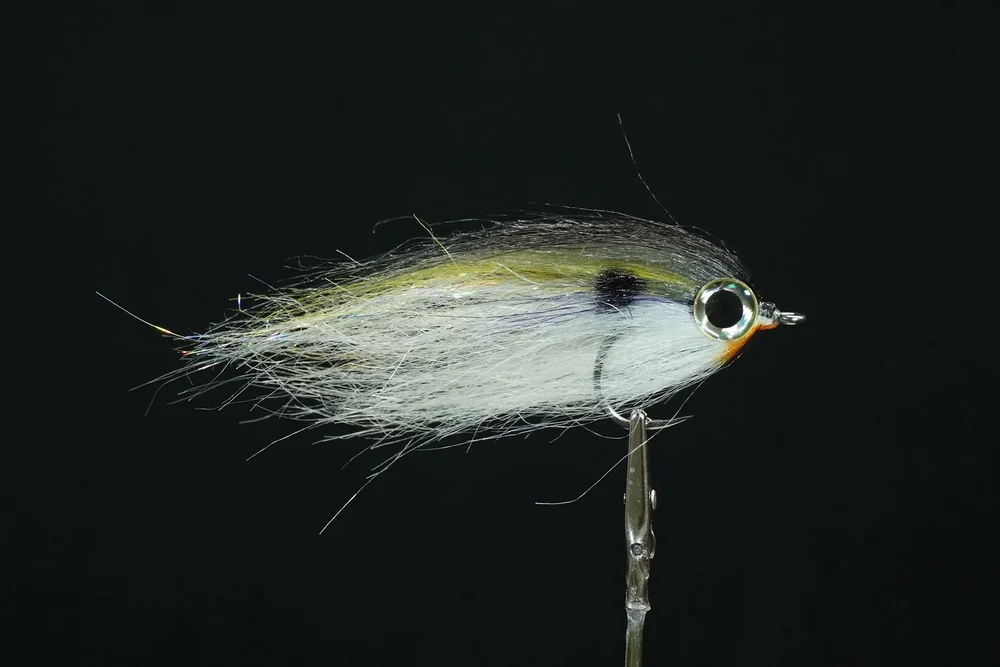
For peanut bunker and finger mullet
MF Mini Hammer Baitfish
4 in · 1/0 hook · weighted body
Shown in Shad; also Mullet and Green/Grey. Product photograph, not shown to scale.
View the Mini Hammer BaitfishFor sand eels, carry slim, weighted flies such as Clousers in a couple of natural colors and the line to get them deep.
For adult bunker and the big fish that follow them late in the season, the Mega Hollow Baitfish is seven inches on an 8/0 hook with a bulky head that pushes water, in colors that include Mackerel and Olive/White. It is a lot of fly to cast, and it is the wrong choice in a school of anchovies, but when the bait is big it shows a fish something worth chasing.
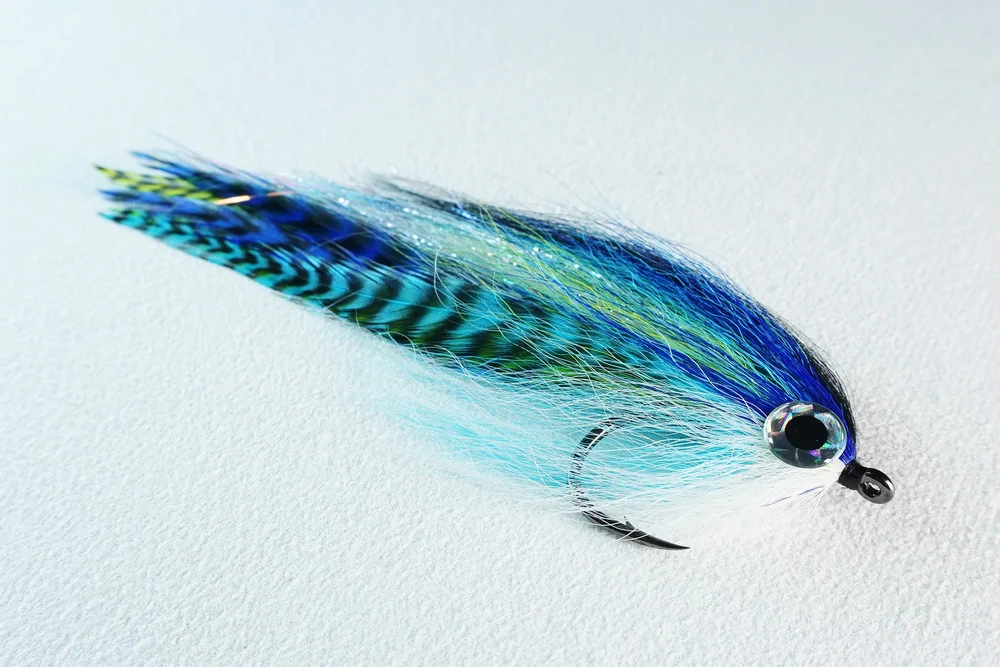
For adult bunker and big bait
MF Mega Hollow Baitfish
7 in · 8/0 hook · bulky head
Shown in Mackerel; colors include Olive/White. Product photograph, not shown to scale.
View the Mega Hollow BaitfishThat is the whole logic of the box: one profile for each bait, sized to the bait, weighted to the depth.
The fish you release this fall
There is a reason to fish this run carefully that goes beyond good form.
The Atlantic striped bass stock is currently classified as overfished, although overfishing is not occurring, and managers are required to rebuild it by 2029. The 2024 assessment update put female spawning stock biomass at 191 million pounds in 2023, below the 197-million-pound threshold. In October 2025 the commission kept current recreational measures in place, but it also noted that Chesapeake Bay recruitment has been weak for seven consecutive years. Those weak year classes are the young fish of this decade, and the commission expects them to make up most of the spawning stock after 2029. Every schoolie released carefully this fall is part of that math.
Most stripers are released, so how they are released matters. The commission uses a 9 percent release mortality rate, a population-level average that traces to a 1996 Massachusetts study by Paul Diodati and Anne Richards. It is not the chance that any one fish dies, and the factors that push it higher are mostly in the angler’s hands: long fights, long air exposure, warm water and rough handling. Virginia’s Department of Wildlife Resources gives the plain version. Use tackle heavy enough to land fish quickly. Wet your hands. Keep the fish in the water or in a rubber net while you unhook it. Never hang a big striper vertically. Support its weight with two hands and let it swim off on its own, facing into the current.

Current coastal rules allow one fish between 28 and 31 inches in the ocean and one between 19 and 24 inches in the Chesapeake, and individual states set their own seasons on top of that. Check the regulations for the water you are fishing before you go.
The run in one decision
Fall gives a fly angler more shots at big striped bass than any other season, and it hides them inside a lot of noise. Birds, boils, boats and bluefish all compete for attention. The anglers who do best through it tend to ask the same question at every stop, and it isn’t where the fish are.
It’s what the fish are eating, and whether your fly looks like it.
