
WHY PERMIT REFUSE YOUR FLY

Permit & The Flat
WHY
PERMIT
REFUSE
YOUR FLY
And what to do about it — a guide to reading refusals, adjusting your presentation, and changing the right variable on your next shot.
The permit was right there. Forty feet off the bow, tailing in six inches of water, completely unaware. You made a good cast. The fly landed quietly. The fish turned toward it, tracked it for three seconds — and then peeled off at the last moment. No eat. No splash. Just gone, angling back to the flat like you never existed.
That sequence plays out thousands of times every season on the flats of the Florida Keys, Belize, Mexico, and the Bahamas. Permit refusals are not accidents. They are decisions made by a fish with exceptionally fine sensory equipment, operating under conditions it has been evaluating since birth. Understanding what drives that decision — and what you can actually change — is the difference between a permit flat that educates you and one that eventually rewards you.
The Refusal Is Not Random
Permit refuse flies for specific, diagnosable reasons. The most common mistake anglers make after a refusal is changing their fly immediately — swapping the Merkin for a McCrab, downsizing the hook, switching from tan to olive. Pattern changes feel productive. They rarely are.
In most cases, the fly was not the problem. The presentation was. And changing the fly without fixing the presentation produces a different refusal for the same reason.
That said, sometimes the fly is the problem — and knowing when to switch requires understanding what the fish is actually evaluating before the eat.
Permit are opportunistic feeders, but they are also extraordinarily cautious in shallow, clear water. A fish that has lived long enough to reach double-digit pounds has encountered lures, flies, spearfishers, and wading anglers. Its threat-detection system is calibrated finely. The moment your fly violates that system in any way — wrong entry, wrong movement, wrong depth, wrong profile — the fish is gone.
“Permit do not refuse flies out of spite. They refuse them because something about the presentation didn’t read as food. That’s the only question worth asking after a refusal: what didn’t read?”
Megafin Fly Fishing JournalWhat a Permit May Be Evaluating
Before a permit commits to eating a fly, it runs through a rapid sensory checklist. Experienced guides have identified several key criteria that permit consistently apply.
1 — Fly Size
Most productive permit crab patterns fall in the #2 to #6 range, with smaller sizes (#4, #6) often outperforming larger ones in calm, clear conditions. When permit are feeding selectively and refusing consistently, dropping hook size by one is one of the most reliable adjustments available.
2 — Sink Rate
A crab that sinks too fast, or that suspends in the water column when it should be descending, does not read as prey. Permit want a fly that sinks at a natural crab rate — a controlled, steady descent toward the bottom. Weighted too heavy and it pancakes to the sand before the fish can close. Too light and it floats like something that isn’t food.
3 — Presentation Angle
The ideal intercept — typically 4 to 6 feet in front of a moving fish, slightly to the offside — gives the permit time to orient toward the fly, track it as it sinks, and commit. Every degree of angle deviation affects how the fish intercepts and evaluates the presentation.
4 — Noise at Entry
In water measured in inches, the sound of a fly landing is significant. A fly that splashes — from a collapsed cast, a rushed delivery, or a fly too heavy for the leader to turn over cleanly — alerts the fish before it has a chance to commit. Quiet entries are not optional on shallow permit flats. They are the baseline.

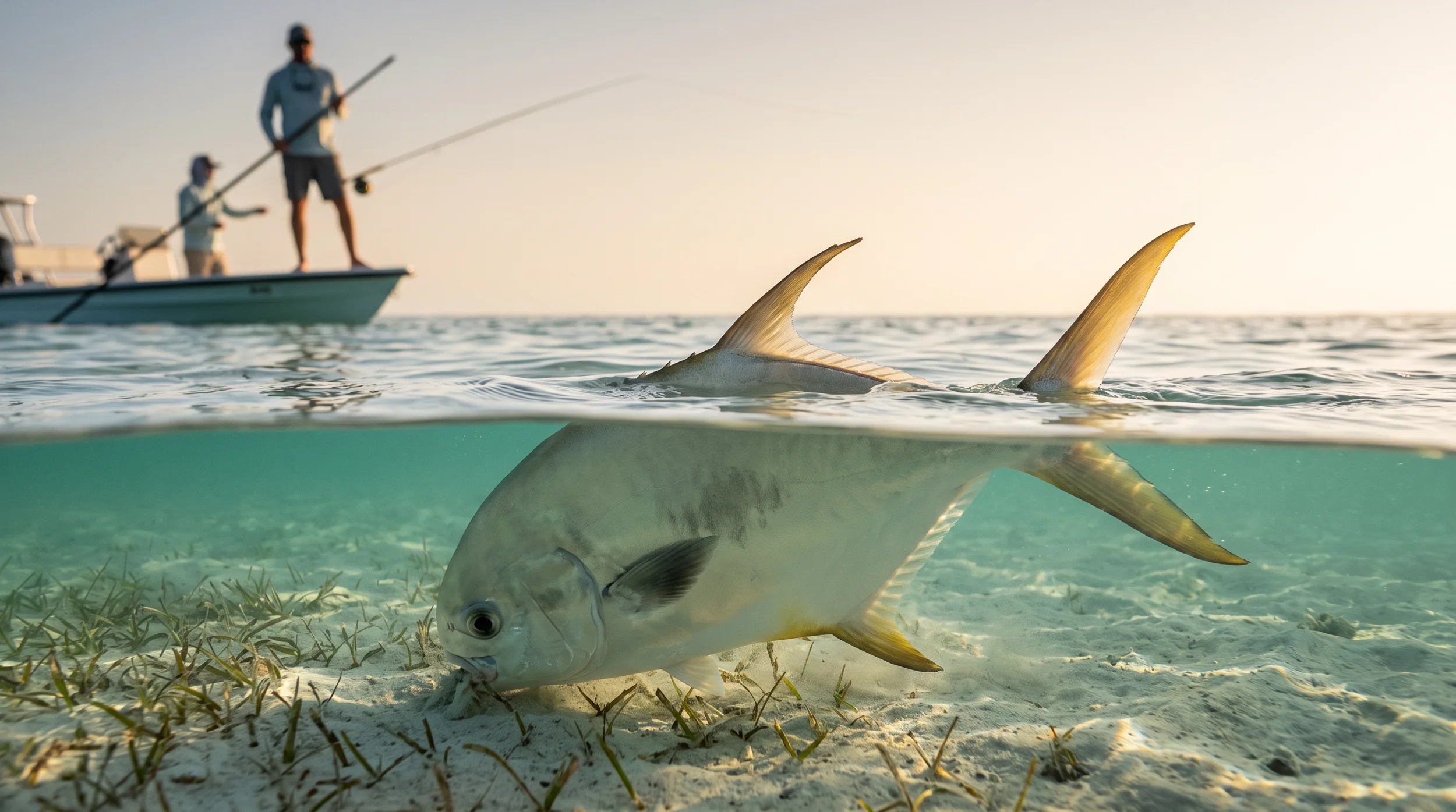
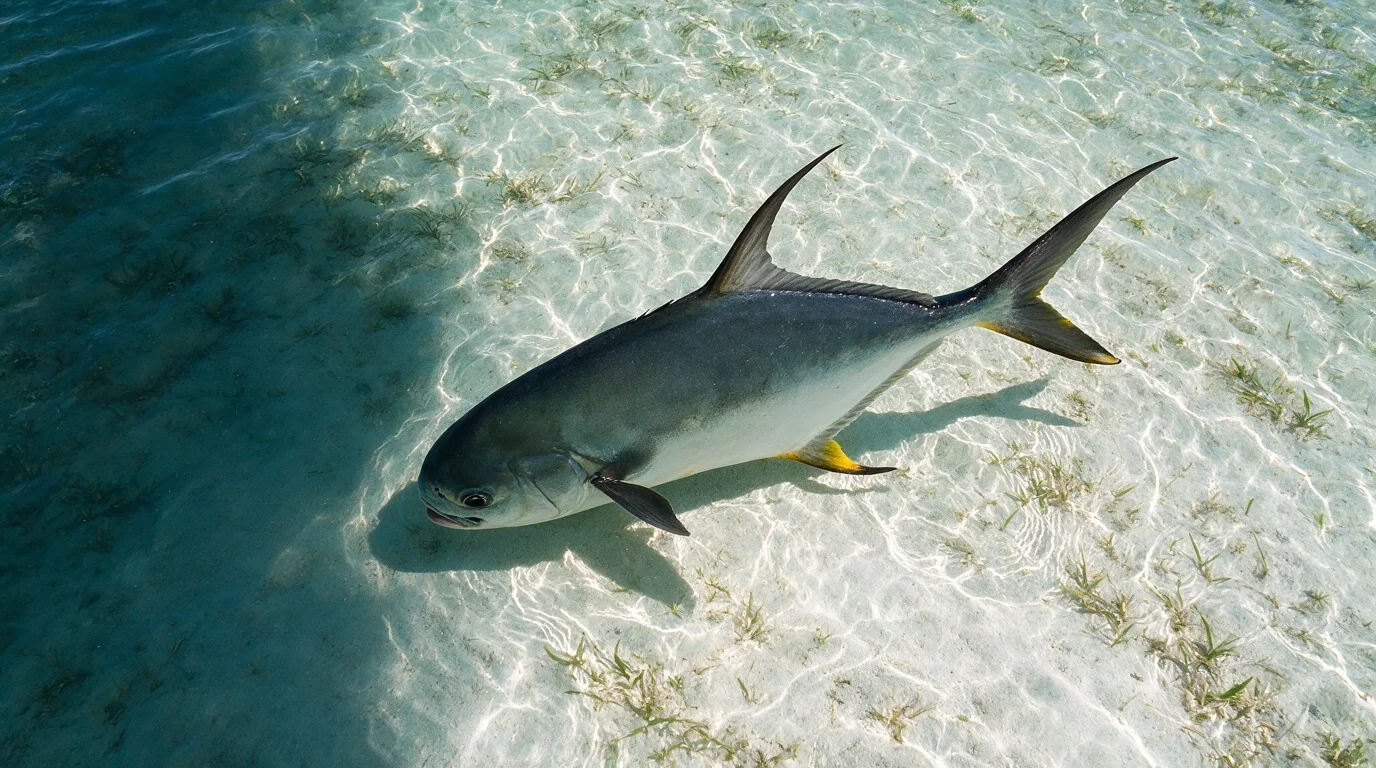
The Moment. A permit tracks a crab pattern to the bottom. The fish’s nose-down posture and proximity to the fly indicate a committed evaluation — the outcome now depends entirely on what happens next.
Read the Moment of Rejection
The fish sees the fly, accelerates toward it, then turns sharply and moves away at speed. This is a threat response, not indifference. The fly spooked the fish — likely from a hard entry, a wrong angle, or a fly that moved unnaturally as the fish approached. Entry and presentation angle are the first things to diagnose.
The fish tracks the fly, gets within inches, then recoils slightly before moving off slowly. This indicates the fly looked wrong at close range — profile issues, the wrong sink rate at the final moment. Pattern evaluation is relevant here. Consider sizing down or changing profile.
The fish stops moving entirely when the fly lands, holds for several seconds, then resumes its original course without investigating. This is a noise refusal. The entry was loud enough to register as a threat. Quiet entry is the single correction. Nothing else will fix a stop refusal.
The fish follows the fly for several feet, tracking closely but never committing. This is typically a retrieve problem. On a follow, let the fly settle and resist the urge to move it — many permit hook-ups come when the angler stops stripping entirely.
After you identify the refusal type, resist the impulse to immediately recast at the same fish. Give the fish a moment to resume feeding behavior, then make your next presentation with the specific correction in mind — not a different fly, but a different presentation of the same fly.
If you can see the fish after a refusal, watch where it goes. A fish that moves shallower and resumes tailing is still catchable. A fish that moves deeper and speeds up is done. Knowing the difference saves you from burning extra casts on a fish that’s already decided.
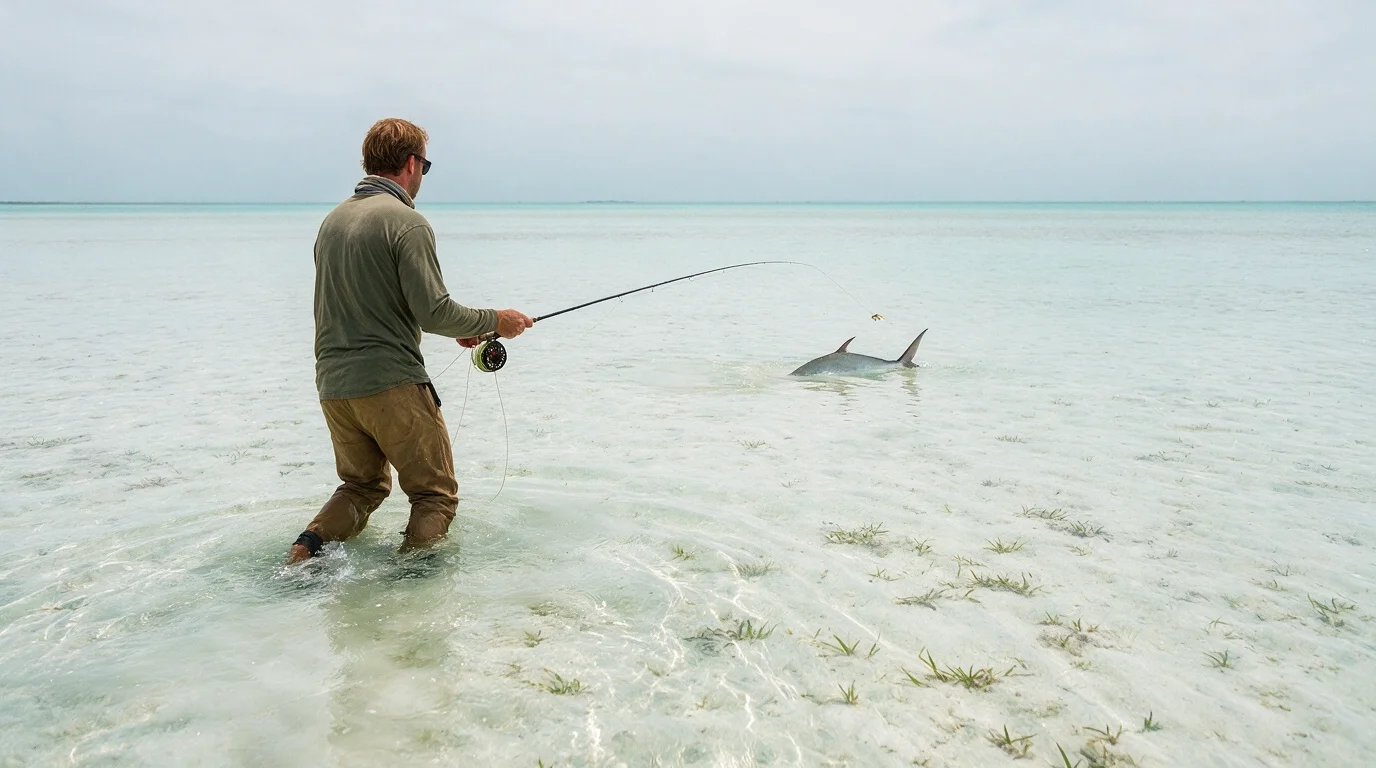
The Intercept. An angler leads a tailing permit by the right margin — far enough ahead for a soft entry, close enough for the fish to find the fly. One shot. One cast.
Presentation Before Pattern
The sequence matters more than most anglers acknowledge. Before you evaluate whether your fly is the wrong fly, evaluate whether your presentation gave the fly a legitimate chance to be eaten.
A permit crab pattern presented correctly to a feeding fish at the right depth and angle will produce takes with reliable frequency. The same pattern presented badly will be refused by every fish that sees it, regardless of its tying quality or pattern accuracy. Here is the presentation sequence that consistently produces eats:
- Identify the fish’s direction of travel and establish its speed before casting. A fish at a 45-degree crossing angle moving at medium pace gives you the most workable intercept window.
- Lead the fish by 4 to 6 feet, slightly to the offside of its tracking line. This forces the fish to redirect slightly — the natural behavior of a predator turning toward prey — rather than having the fly land directly in its path.
- Wait for the fly to sink to approximately the fish’s eye level before allowing any movement. Permit eat on the sink more often than on the strip.
- If the fish tracks but doesn’t commit, one short, slow strip is acceptable. A single strip followed by a complete stop has produced more hook-ups than any active retrieve technique.
- Set on feel, not on sight. The permit eat is often quieter than you expect. Strip-set hard. Do not trout-set.
“The cast has to lead the fish, not chase it. Once you’re casting behind a permit, the presentation is already over.”
Guide principle, Florida Keys flatsThe presentation window closes faster than beginners expect. From the moment the fly hits the water to the moment the permit passes the landing zone is often three seconds or less. Every element of the presentation must be right on that first cast. There is rarely a second chance at the same fish in the same position.
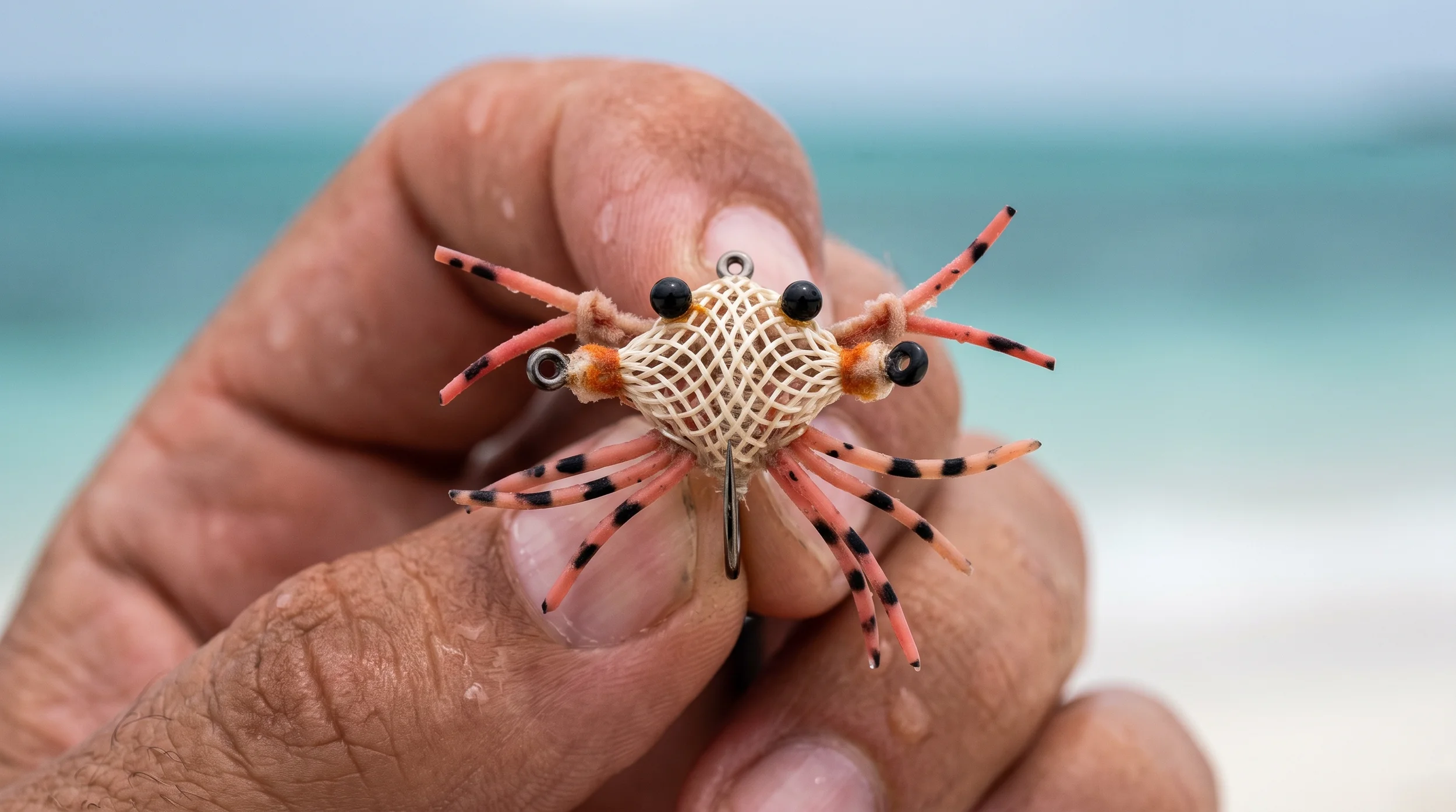
MF Alphlexo Crab. The open-mesh lattice, rubber legs, and precise weighting distinguish the Alphlexo from generic crab patterns — built to sink on the right angle and hold the right profile at depth.
When the Fly Really Is the Problem
After you’ve eliminated the presentation — quiet entry, correct lead, appropriate sink rate — and permit are still refusing consistently, the fly becomes the variable to change.
Water clarity. In exceptionally clear water with high sun angle, sparse, lightly tied patterns outperform heavily dressed flies. Permit have the best possible view of your fly and they will use it.
Fishing pressure. In heavily fished areas, permit have seen the major patterns repeatedly. A more obscure offering — or a significantly different profile — can produce takes from fish that have refused standard presentations dozens of times.
Size mismatch. If the flat’s crab population is running unusually small, a standard #2 pattern can look dramatically oversized. Downsizing to #4 or #6 is often the most impactful single change available.
Change One Variable At a Time
The most common mistake after a series of refusals is changing multiple variables simultaneously. New fly, different retrieve, different lead distance — everything changes at once. When the next fish eats, you don’t know what worked. When it refuses, you don’t know what failed. Change one variable, observe the result, proceed.
| Refusal Type | Most Likely Cause | First Correction |
|---|---|---|
| Hard Turn / Flight | Entry noise or fly landed on fish | Softer entry, longer lead distance |
| Flinch at Close Range | Profile wrong at inspection distance | Size down one hook size |
| Stop & Ignore | Landing noise registered as threat | Quieter presentation — nothing else |
| Long Follow, No Eat | Fly moved during the track window | Hold completely still on the next follow |
| Fish Never Turns | Fly landed outside visual window | Tighter lead — closer to tracking line |
“Every permit that ever refused your fly was still there on that flat, still feeding, completely unbothered. They didn’t beat you. The next cast is still your chance.”
Megafin Fly Fishing Journal · Permit SeriesThe Long Game on the Flat
Permit fishing has a catch rate that humbles every angler who pursues it seriously. Even on a productive flat, with a good guide, in the right conditions, permit-to-cast ratios remain low by any standard. That is not a failure of the system. That is the nature of the fish.
What separates anglers who eventually catch permit from those who don’t is not luck or connections or a special fly. It is the accumulation of specific knowledge: what a real refusal looks like versus a miss, what a feeding fish looks like versus a nervous one, how to read the flat’s depth and bottom structure before the fish appears. Permit refusals, observed carefully, are the curriculum.
Each refusal tells you something. The hard turn says your entry was too loud. The flinch says your profile was wrong at inspection distance. The follow that never converted says your fly moved at the wrong moment. If you are logging these observations — even mentally — you are building the diagnostic model that eventually produces hook-ups.
“The permit is the graduate-level exam for anyone who takes saltwater fly fishing seriously. It will expose every flaw in your presentation and reward every correction with what feels like a miracle.”
Megafin Fly Fishing JournalThe fly matters — but not as much as you think after the first refusal. Make the presentation right first. Then let the fly do its job. That’s how you turn a refusal into an eat.
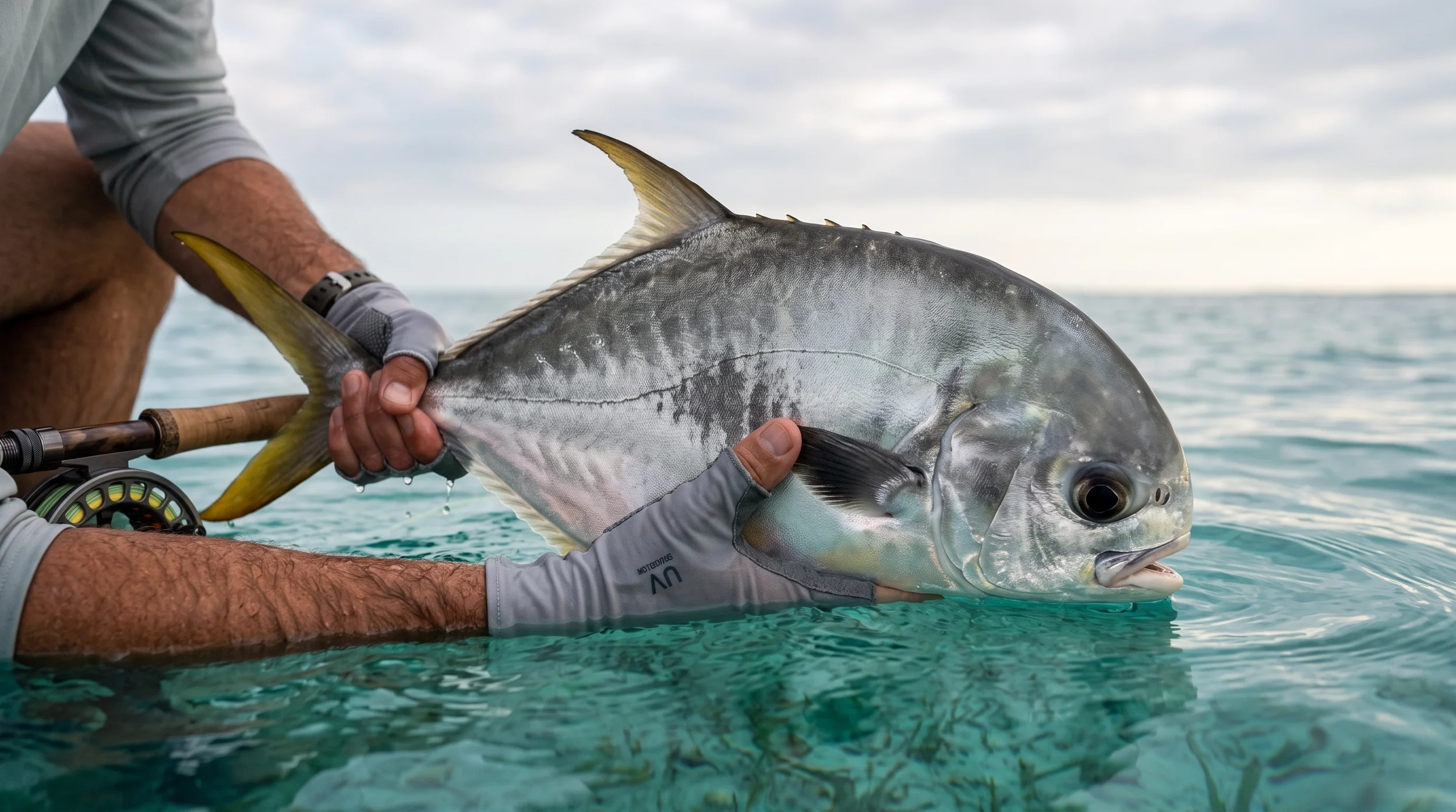
The Payoff. A permit held at waterline before release. Every refusal that preceded this moment was part of the process — not failure, but diagnostic data the next cast was built on.
BUILT FOR
THE FLAT.
TIED FOR
THE EAT.
The Permit & Bonefish Fly Assortment brings together the crab and shrimp patterns that consistently pass permit inspection — weighted correctly, profiled correctly, tied on corrosion-resistant saltwater hooks. Twelve patterns selected for the Florida Keys, Bahamas, Belize, and Caribbean flats.
Everything in this box was chosen because the presentation earned a fair look. The fly did the rest.
See the Permit & Bonefish Assortment
MEGAFIN FISHING COMPANY · Premium Predator Fly Fishing · megafinfishing.com
Permit & Bonefish Assortment · Florida Keys, Bahamas, Caribbean, Belize
