

Bass Poppers: How to Fish Topwater Flies for Maximum Strikes
Megafin Journal · Technique & Presentation
Bass Poppers: How to Fish Topwater Flies for Maximum Strikes
Topwater bass fishing is won on rhythm, not the fly. A field guide to placement, the pause, cadence, the missed strike, and the set — for largemouth and smallmouth.
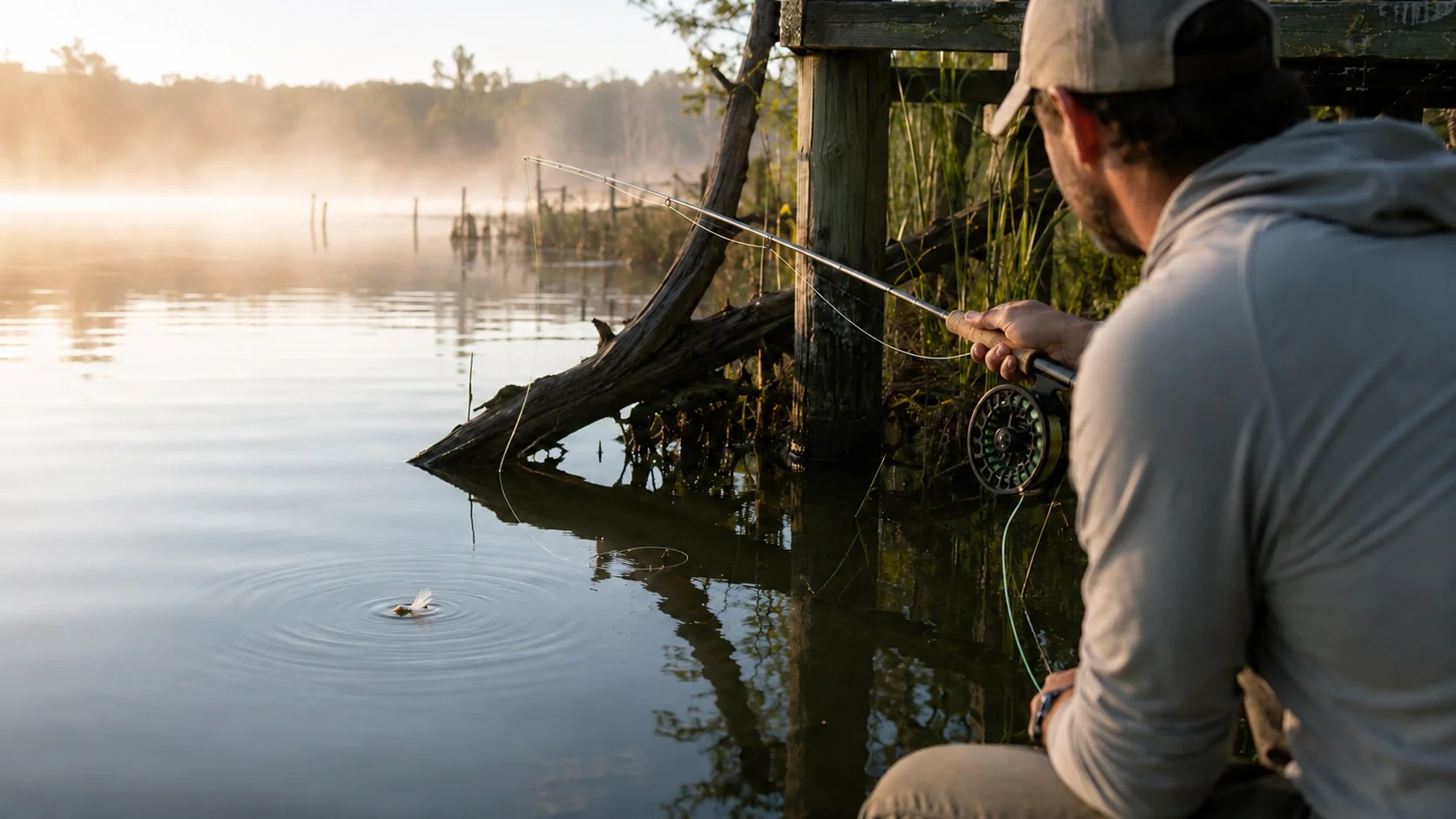
The popper lands a hand’s width off the dock post, close enough that the leader ticks the wood on the way down. The rings spread and flatten. You do nothing. For a long three‑count the bug just sits there, a small foam intruder on still water, and nothing in the pond seems to care.
Then you give the line one short pull. The head digs in, spits a low bloop, and the water underneath it bulges. A largemouth that was tucked in the shade of the piling the whole time turns and takes it off the surface with a sound like a boot pulled out of mud.
Nothing about that fish was caught by the fly. It was caught by the placement, the pause, and one small decision about when to move.
The fly is the easy part
Topwater bass fishing gets sold as a gear problem. Pick the right popper, the pitch goes, and the fish will come. On the water it runs the other way around. A thoughtful angler will pull strikes out of a plain bug, and a beautiful bug fished on a metronome will send fish to the bottom. Poppers reward rhythm and observation far more than they reward pattern selection.
The popper is an instrument. The fishing is in how you play it. Everything that decides the outcome happens after the bug hits the water: where it landed, whether your first move is a twitch or stillness, the cadence you build, what the fish shows you, and how you turn a boil into a hooked fish. This is a guide to those decisions.
The popper is an instrument. The fishing is in how you play it.
Start where the fly lands
No retrieve rescues a bad cast. In warm water a largemouth is an ambush feeder that holds tight to cover and won’t move far to eat, and the hotter it gets the less ground it will give up. That makes placement the first and largest variable. You want the bug working through the strike zone, not swimming toward it.
Practically, that means casting tight — not close, tight. Lay it parallel to a weed edge so it tracks the seam the whole retrieve instead of crossing it once. Put it against laydowns and dock pilings, under overhangs, along the line where rock gives way to sand. Smallmouth in a river ask a different question but the same discipline: they sit on current breaks, behind boulders, at the downstream lip of a gravel bar, facing up into the flow and waiting for food to tumble down to them. Drop the bug above the seam and let it ride the break. If a spot only gives you one clean drift, make the placement earn it.
What a popper actually does
It helps to be honest about what these flies imitate, which is often nothing in particular. A cupped or concave face shoves water when you pull it, throwing a pop and a spray that a fish can locate from across a flat. Most poppers read as a struggling, vulnerable something — a drowning insect, a wounded baitfish, a frog that swam where it shouldn’t have — rather than a faithful copy of any one of them.
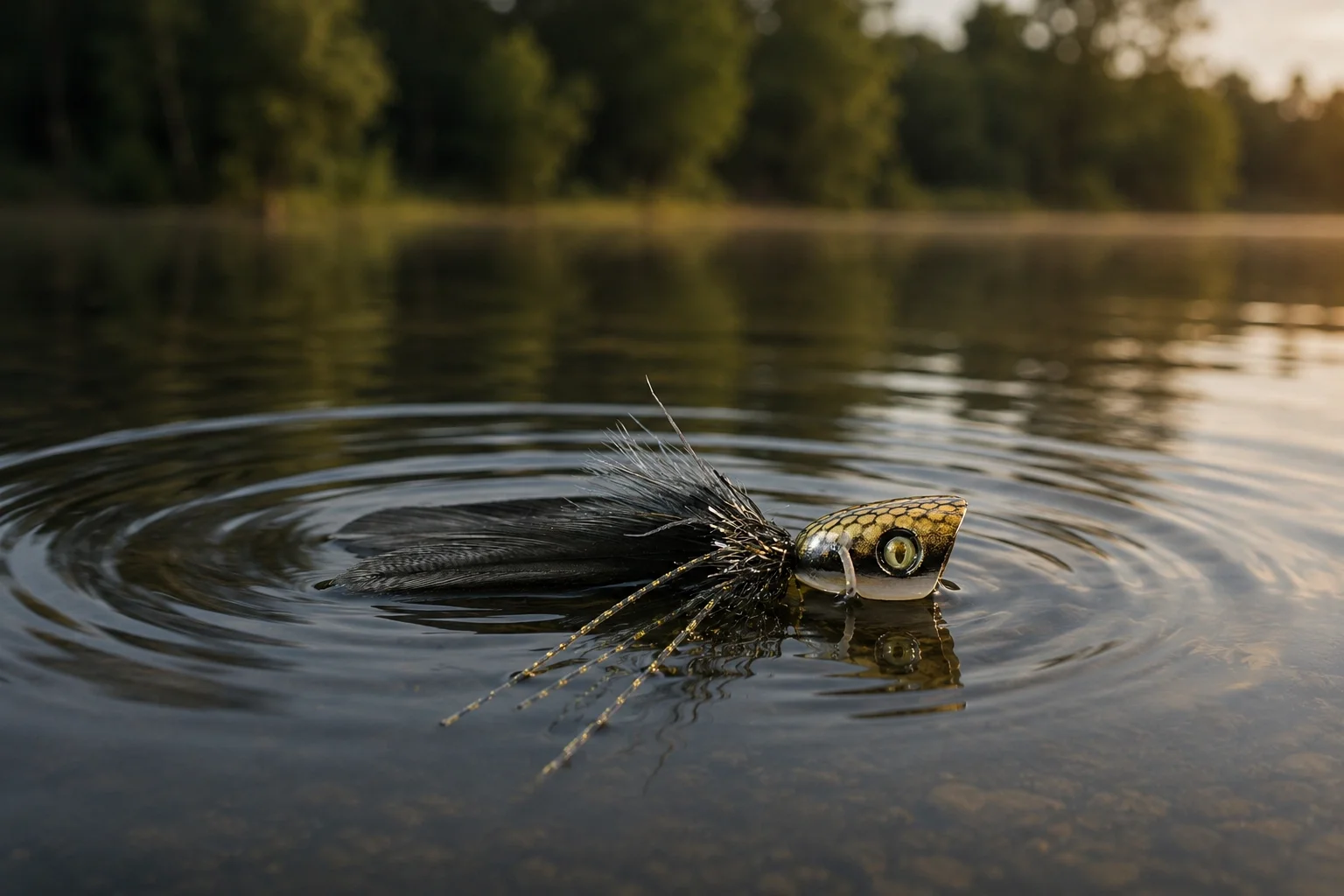
What changes from design to design is how much commotion the bug makes and how it behaves when it stops. Hard foam and cork float high and pop crisp and loud, and foam is close to indestructible. A deer‑hair bug lands softer, sits lower, and makes a deeper, gurglier sound while pushing more water, though it will also draw fish that follow and don’t commit. A slider or a Gurgler‑style bug rides low in the film and wakes and bubbles instead of popping, which reads more like a struggling baitfish and casts far easier. A diver ducks under on a hard strip and floats back up, which puts the eat on the rise.
One tying detail is worth knowing because it explains the pause: bugs are usually built so the body material stops at the hook point, letting the fly ride tail‑down and head‑up, the posture of something dying at an angle. Since a lot of your strikes come while the bug is sitting still, that posture is doing quiet work for you. The takeaway is simple. Match the amount of disturbance to the water and the mood of the fish — a loud face for chop, stained water, and fish that need to be called up; a quiet wake for calm, clear, pressured water.
The first move
The most useful decision you’ll make comes right after the fly lands, and it has no default answer.
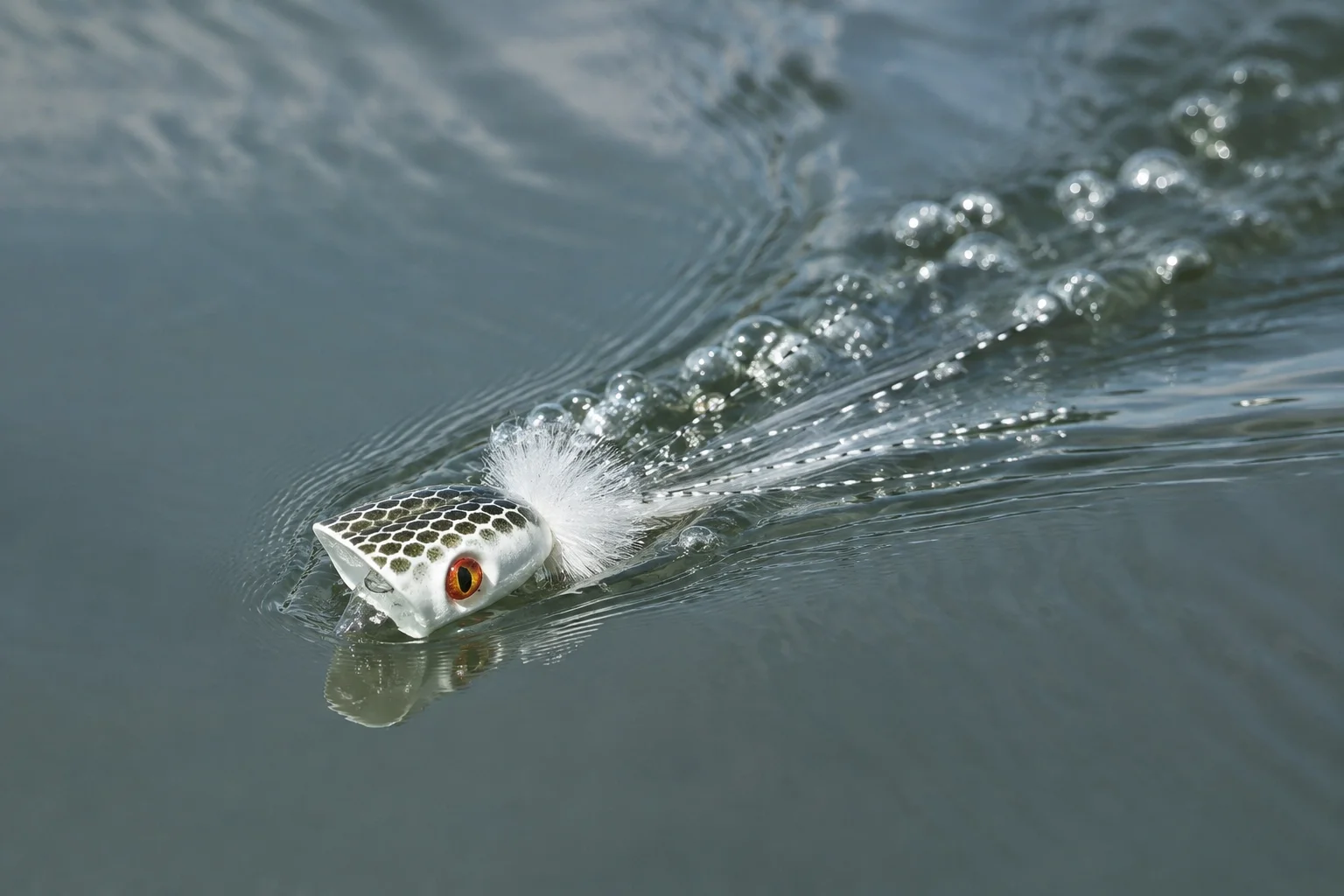
The standard advice is to let the rings dissipate before you touch it, and the reasoning is good. The splashdown is itself a trigger, a fish that turned toward the plop is often already on the way, and a lot of eats happen while the bug sits dead or on the very first twitch. Bass, like trout, get conditioned to insects that fall and then hold still. So start there, especially on calm water and pressured fish: land it, wait until the surface settles, then move it.
But that’s a starting point, not a rule. The most honest version of this advice, argued out years ago between the Orvis crew and the writer Bill Tapply, is to open with the wait‑and‑settle method and abandon it the instant it stops producing. On stained water, in wind, or when fish are actively chasing bait, they may want something already moving — put it in motion before the rings fade. Let the fish cast the deciding vote. If a handful of settle‑then‑move casts draw nothing, flip the whole thing over and move it immediately, or move it hard.
Cadence is a decision
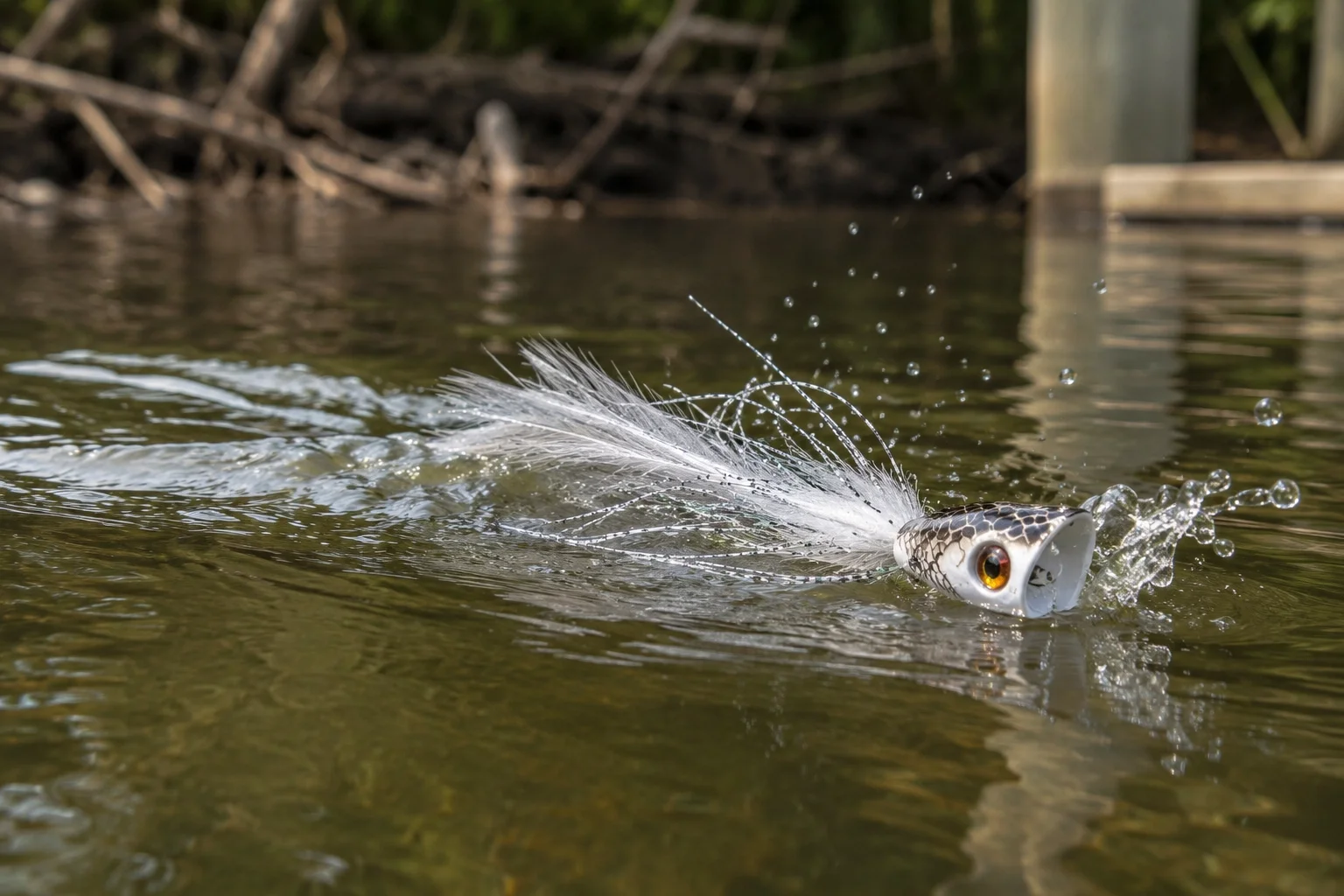
Most anglers, once they find a retrieve that works, run it on a loop. Pop, pop, strip, pop. Bass see through that fast. Cadence should be a response to how the fish are behaving this hour, and it will change through the day. A few rhythms are worth carrying, less as recipes than as options you test.
One pull to make the head speak, then a real stop — anywhere from a few seconds to an uncomfortable fifteen or twenty on hard‑fished water. Most eats land in that pause.
When you don’t know the mood yet, start here.The double pop announces the bug across a wider stretch of bank; the long pause sells the kill.
Searching and covering water for aggressive or scattered fish.Short, continuous strips hold a constant pulsing wake with few or no stops — best for a slider or Gurgler, where a pause breaks the illusion.
When fish key on moving bait, and in low light over open water.A small rod‑tip jiggle — not a full pop — when you can see a fish drift up and inspect without eating. Downsize the input, not just the fly.
For a visible follower that won’t commit.Cast, and do nothing at all. On glassy ponds and pressured water a bug that never moves reads like a real insect that dropped in and drowned.
Calm, clear, heavily fished water. It’s agonizing. It works.The point of all of this isn’t to memorize six retrieves. It’s to treat cadence as a live variable, and to change it before you decide the fly is the problem.
Treat cadence as a live variable — and change it before you decide the fly is the problem.
Two fish, two problems
Largemouth and smallmouth both eat on top, but they don’t hunt the same way, and the difference should change how you fish.

Largemouth are cover‑and‑ambush fish. They bury in vegetation, wood, docks, and shade and let the meal come to them, so your job is accurate placement and patience against structure. In heat they hold tight and refuse to travel, which is exactly why a slow pop‑and‑pause laid right on the cover beats a bug ripped across open water.
Smallmouth, especially in rivers, are current fish with sharper eyes and an appetite for a moving target. They hold on seams and gravel‑bar lips and will chase, which rewards a livelier retrieve and a bug with a profile that pushes water. They also carry, as more than one guide has put it, a few trout tendencies: in clear water they often want a subtler presentation and a smaller bug, and they’re streaky in a way largemouth aren’t — collectively on, then off, for reasons they don’t share with you.
| Variable | Largemouth | Smallmouth |
|---|---|---|
| Typical water | Ponds and lakes; weed, wood, docks | Rivers and clear lakes; rock and current |
| Position | Buried in cover, ambushing | On seams and gravel bars; will chase |
| Retrieve lean | Slower pop‑pause, tight to structure | More movement; wake and twitch on the seam |
| First priority | Placement and patience | Reading the current, covering water |
| Bug size lean | Bigger is fine, especially in cover or stain | Often scale down, especially in clear water |
| Temperament | Aggressive, opportunistic | Streaky — on, then off |
When the fish misses
A topwater miss isn’t a failure. It’s information, and it’s one of the most catchable moments in the sport — as long as you don’t ruin it.
The instinct is to strike at the splash. Don’t. On a boil, a swipe, or a short slap, the fish very often hasn’t got the fly. If you set on the blow‑up and there’s nothing there, you’ve just yanked the bug a foot away and shown the fish the trick. Instead, when the water erupts, do nothing with the rod. Give one short strip to feel for weight. If you feel the fish, set. If you feel nothing, the fish missed and the bug is still in the game — let it sit dead for several seconds, as if the prey had been stunned by the swipe, then twitch it. Fish come back, sometimes after two or three swipes at the same bug. If a fish shows and doesn’t connect, work the spot again before you move on. Interested fish rarely refuse a clean second look.
The set
This is where trout anglers lose the most bass. The reflex from dry‑fly fishing is to lift the rod, and on a popper that lift does two bad things at once: on a miss it pulls the bug up and out of reach, and on an eat it loads the rod softly against a hard, bony mouth that needs a firm, direct pull to take a hook.
Set with the line, not the rod. Keep the rod tip low and pointed straight at the bug through the entire retrieve. When a fish eats, strip hard and steady with your line hand and sweep the rod low to the side; let the strip drive the point home, then raise the rod to fight. Two more things matter. Timing: set on what you feel, not what you see. A largemouth’s strike happens in roughly a tenth of a second, so a short beat — just long enough to feel the fish’s weight come onto the line — puts the hook into a closed mouth instead of an open one. With practice you stop counting and simply set when you feel weight. And slack: too much loose line on the water and you can neither move the bug properly nor drive a hook through the belly of the line. Keep enough tension to make the fly pop and to feel a take. The strip set has a mercy built in — miss the fish, and the fly is still there for another try.
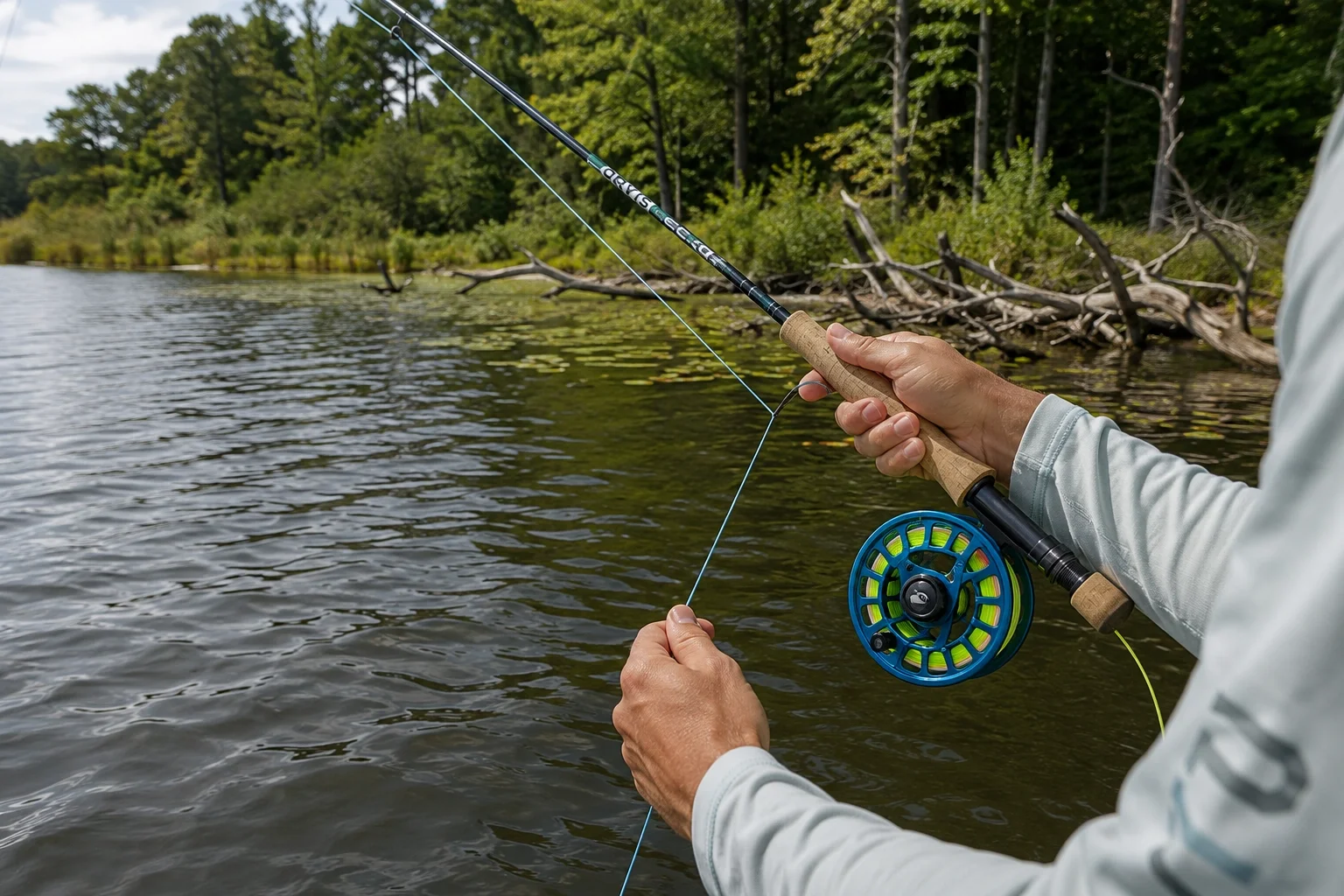
The set, in order
- Rod low, pointed straight at the bug.
- Keep just enough tension to feel a take.
- Strip‑set: pull hard and steady with the line hand, sweeping the rod low to the side.
- Set on feel — once you feel the weight, not on what you see.
- Then raise the rod to fight.
Smaller isn’t weaker
More splash is not more fish. A bigger, louder bug calls fish from farther and suits stained water, chop, and genuinely aggressive fish. But there are days a big bug is exactly wrong: pressured water where the fish have seen every kind of commotion, clear ponds where a quiet wake outdraws a chug, cool or bright bluebird conditions, and much of your smallmouth and panfish work. Scaling down usually means a smaller, quieter head, or a switch from a cupped popper to a slider or a Gurgler that wakes instead of pops. You trade reach for realism. A smaller bug won’t pull a fish across the flat, but it will convince the ones already close.
Color, kept honest
Anglers overthink popper color and underthink silhouette. A bass eating off the surface sees the bug from below, as a dark shape against a bright sky, so contrast reads long before hue does — and the research suggests bass discriminate color less finely than we imagine, seeing reds and greens best and treating bright shades like white and chartreuse as much the same thing. The practical version is short. In clear water and bright light, lighter bugs read clean and flash like a baitfish flank. In low light or stained water, dark bugs throw the sharpest silhouette. Frog tones earn their keep around lily pads and mats. Beyond that, the most underrated reason to choose a color is so you can see it — a bug you can track lets you read a follow, catch a subtle take, and time the twitch that seals it. Keep one dark and one light in the box and put the saved energy into the retrieve.
Six ways to talk yourself out of fish
- Fishing fast, every cast, with no real pauses.
- Running one cadence all day instead of testing new ones.
- Twitching the bug the instant it lands, every time, so it never gets to sit.
- Casting near cover instead of tight to it — bass won’t come far to find you.
- Setting on the splash, and setting with the rod.
- Reaching for a new fly before trying a new retrieve.
Change the retrieve before you change the fly
That last one deserves its own line, because it’s the most expensive habit in topwater fishing. When a stretch goes quiet, most anglers change flies. Usually the fly was fine. Before you cut it off, change what you’re doing to it: slow down or speed up, lengthen the pause, add or drop the pop, come at the cover from a new angle, put the bug tighter to the wood. Cadence, pause, speed, angle, placement — those are your dials, and they cost nothing. Work through them first. If you’ve honestly tried them all and still can’t buy a look, then change the bug, and change it smaller and quieter before bigger and louder.
Change the retrieve before you change the fly.
Put together, a piece of water reads something like this.
- Find the cover or the current, and plan a cast that keeps the bug in the strike zone longest.
- Land it and wait — be ready for an eat on the drop and on the first twitch.
- If nothing comes, build a cadence: pop‑and‑pause to start, more pops and shorter pauses if fish are up, subtler or dead‑still if they’re sulky or the water’s calm and clear.
- If a fish shows but won’t eat, downsize the input before the fly.
- On a miss, don’t set — strip to feel, then let it sit and twitch.
- On an eat, set with the line, rod low, after you feel weight.
- If the whole spot dies, change the retrieve, then the angle, then the size — in that order.
Conditions tilt the dials: warm water and low light favor topwater and aggression; heat, glare, cold fronts, and pressure favor slower, smaller, subtler. None of it is law. The fish rewrite the rules daily. The whole job is to keep asking them what they want.
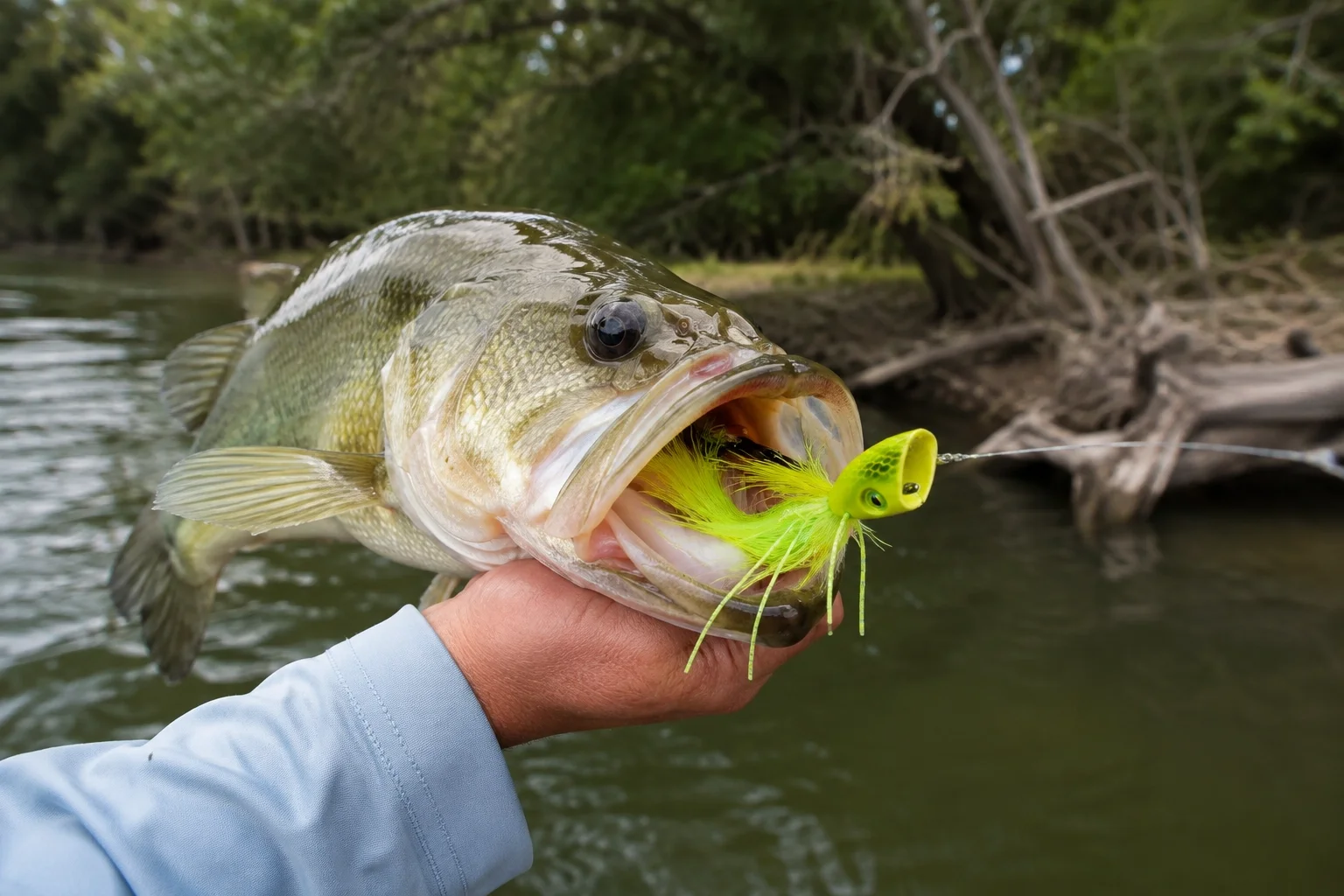
From the water to the box
By the time a popper is doing its work, you’ve made a dozen small decisions the fly never made for you. What the fly owes you in return is honesty: a head that makes the disturbance you asked for, a hook that holds when a bass eats hard, and a shape that reads right when it sits still.
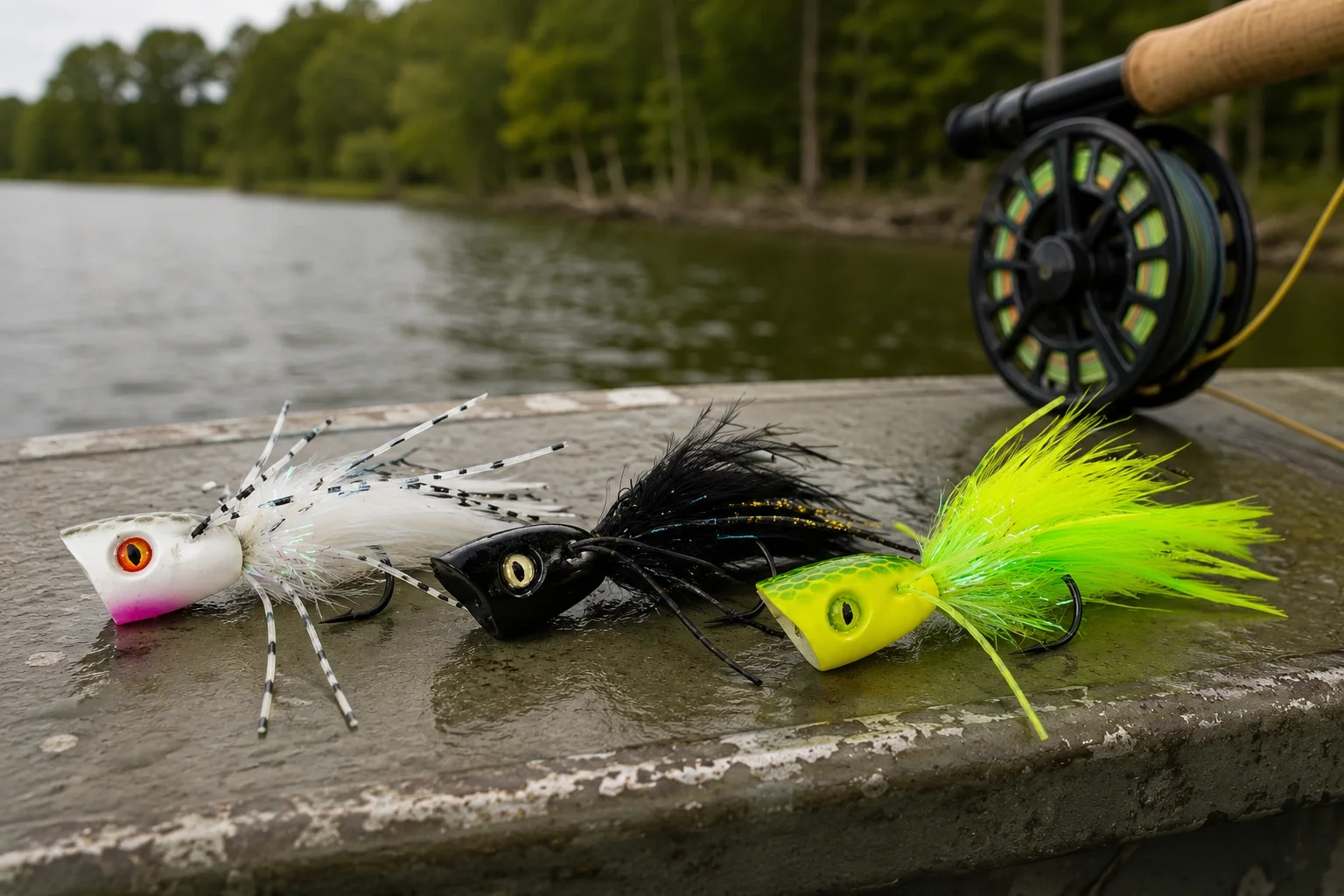
Mega Bass Bug Popper
Built for the loud end of everything above — an oversized cupped foam face that throws a real pop, frog eyes and a froggy profile for lily‑pad water, and a sharp black‑nickel #2 hook for that hard, bony‑mouthed strike. It comes in three colors that map straight onto the silhouette logic above: white and chartreuse for bright light and clear water, black for low light and stain. When the fish want the quiet end instead, the Mega Gurgler covers the wake‑and‑bubble presentation.
Fish the Mega Bass Bug PopperLate in the evening the pond goes to glass and there’s no sense left in moving the bug, so you don’t. You cast it beside the same dock post, let it sit until you’ve half forgotten it’s out there, and watch. Somewhere under the piling a fish is deciding.
The popper didn’t earn that fish. The stillness did.
Common questions
How long should you pause a bass popper?
Often a few seconds — from letting the rings settle up to fifteen or twenty on calm, pressured water. It’s a variable to test, not a fixed number, and most eats come during the pause.
What’s the best retrieve for bass poppers?
Start with one pop and a pause, keep it erratic rather than steady, and change the cadence based on how the fish respond that day.
How do you set the hook on a bass popper?
Strip‑set: rod tip low and pointed at the bug, a hard line‑hand strip, and set on feel — once you feel the fish’s weight, not on the splash.
Why do bass miss poppers?
Many “misses” are boils and swipes where the fish hasn’t taken the fly. Don’t set on sight — strip to feel; if nothing’s there, let it sit and twitch.
Do popper colors matter for bass?
Silhouette matters more than exact hue. Light bugs in clear or bright water, dark bugs in low light or stained water — and pick a color you can track on the surface.
